

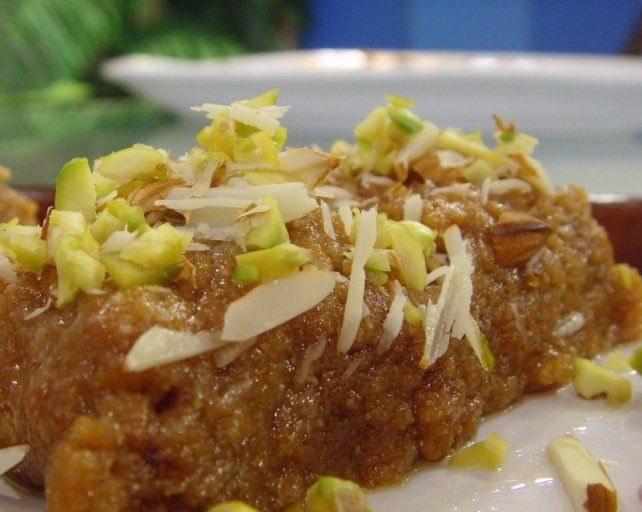
Short answer: 100 g of sohan halwa carries 400 to 500 kcal. A small piece of about 25 g lands near 100 to 125 kcal, while a full 100 g disc can cover most of a day's sugar budget on its own. The range is wide because ghee and sugar do almost all of the work, and different makers use very different amounts of both.
Sohan halwa is Multan's signature sweet, and the one that travels home in tin boxes from every trip south. Sprouted wheat flour, milk, sugar, and desi ghee are cooked down slowly for hours until the mixture turns glossy, dense, and chewy, then set in a tray and finished with almonds, pistachios, and cardamom. The sweet traces back to the Mughal era, and Multan's famous Hafiz shop has sold it since 1930. It shows up at weddings, at Eid, and in winter, when a piece with hot chai feels like the correct thing to do.
What moves the number
Ghee. This is the main driver. Ghee is nearly pure fat, and one tablespoon carries about 120 kcal. A halwa cooked the traditional way, with ghee folded in until the mixture shines, holds far more fat than a lighter homemade batch. The fat per 100 g runs 20 to 25 g in most published figures, and a very ghee heavy version can reach 36 g.
Sugar. The second driver, and the one that matters most for the day as a whole. Sohan halwa holds 30 to 45 g of sugar per 100 g. The World Health Organization advises keeping free sugars below 10 percent of total daily energy, about 50 g on a 2,000 kcal diet, with further benefit below 5 percent (WHO healthy diet fact sheet). One 100 g disc can use up 60 to 90 percent of that daily limit by itself. A 25 g piece uses closer to a fifth.
Nuts. Almonds, pistachios, and walnuts sit on top and through the halwa. They add protein and minerals, and they also add fat, so a heavily topped piece runs a little higher than a plain one. The difference is small next to the ghee and sugar, but it is real.
The piece. Sohan halwa is usually sold as round discs or cut into square pieces, and nobody's piece weighs the same as the next person's. A thin disc might be 30 g. A thick slab from a gift box can pass 100 g without looking large. Weighing one piece once fixes your estimates for good, because guessing by eye is where the numbers go wrong.
The numbers behind it
Published nutrition figures agree closely. Hafiz, the best known Multan maker, lists 450 to 500 kcal per 100 g, with 55 to 60 g of carbs, 22 to 25 g of fat, and 6 to 8 g of protein (Hafiz Sohan Halwa nutrition). Other sellers and recipe sites land in the same band, 400 to 500 kcal per 100 g, with sugar at 30 to 35 g in the leaner estimates and up to 45 g in richer ones. One Jaipur maker's label runs hotter, 575 kcal per 100 g with 36 g of fat, which shows what happens when the ghee hand gets heavy.
| Sohan halwa | Portion | Calories | Protein | Carbs | Fat |
|---|---|---|---|---|---|
| Small piece | ~25 g | 100 to 125 | 1 to 2 g | 13 to 15 g | 5 to 6 g |
| Medium piece | ~50 g | 200 to 250 | 3 to 4 g | 25 to 30 g | 10 to 13 g |
| One 100 g disc | 100 g | 400 to 500 | 6 to 8 g | 50 to 60 g | 20 to 25 g |
| 100 g, extra ghee and nuts | 100 g | 500 to 575 | 6 to 8 g | 55 to 62 g | 25 to 36 g |
The sugar inside those rows is worth stating plainly. A 25 g piece holds about 8 to 11 g of sugar. A 50 g piece holds 15 to 22 g. The full 100 g disc holds 30 to 45 g. If you eat one small piece after dinner, the sugar stays modest. If you eat the disc, you have spent most of the day's sugar in a single sitting.
Logging it in CalsFlow
Type "1 piece sohan halwa, about 30 g" into CalsFlow and it assumes a typical Multani piece, returning roughly 120 to 150 kcal. Change the portion to a 100 g disc and the estimate jumps to 400 to 500 kcal. That gap is the whole lesson with this sweet. The name alone tells you almost nothing. The weight of the piece tells you nearly everything, so weigh it once or compare it against a known 100 g disc and adjust from there.
Is sohan halwa good for weight loss?
Not as a habit, but a small piece fits fine. The problem with sohan halwa on a cutting day is not that it is uniquely bad. It is that it is dense, sweet, and easy to keep eating, with almost no fiber or water to slow you down. A 25 g piece after a meal is about the size of a small snack and costs 100 to 125 kcal. Two or three pieces, which is how gift box halwa usually goes, pass 300 kcal before you have noticed.
If you want it in your day, decide the piece before you open the box. Cut one small square, put the box away, and eat it with chai rather than on an empty stomach. The chai slows you down, and the protein and fat in the halwa keep you full for a while after. The sugar free versions some shops sell now are worth a look too, though they keep the ghee and the calories, so they solve the sugar problem and not the calorie one. If your day already includes other sweets, the Pakistani food calorie chart puts sohan halwa next to gulab jamun, kheer, and gajar ka halwa, and the comparison is instructive. Gajar ka halwa runs 240 to 280 kcal per 100 g, roughly half the density, because carrots and milk carry water that sohan halwa does not.
FAQs
How many calories are in one piece of sohan halwa? A small piece of about 25 g has 100 to 125 kcal. A medium 50 g piece has 200 to 250 kcal. A full 100 g disc has 400 to 500 kcal.
How much sugar is in sohan halwa? About 30 to 45 g of sugar per 100 g, depending on the maker. A small 25 g piece has roughly 8 to 11 g of sugar.
Is Multani sohan halwa different from other sohan halwa? Yes, in the details. Multani sohan halwa uses a sprouted wheat flour base and pure desi ghee, cooked slowly until dense and chewy. Other cities make their own versions, and every halwai adjusts the ghee, sugar, and nuts, so the calories move with the recipe. The ranges above cover the usual spread.
Sohan halwa is a winter gift, a wedding sweet, and a Multan institution, and none of that changes when you know the numbers. A small piece is a reasonable treat. A whole disc is a meal's worth of calories and most of a day's sugar, eaten in about four bites. Log the piece you actually ate, not the piece you meant to eat, and it fits. Try it in CalsFlow: describe the piece, set the weight, and see where it lands. Get CalsFlow on Google Play
Photo: Multani sohan halwa discs by Bhutta1984, CC BY-SA 3.0, via Wikimedia Commons.
CalsFlow provides nutrition estimates, not medical advice.