

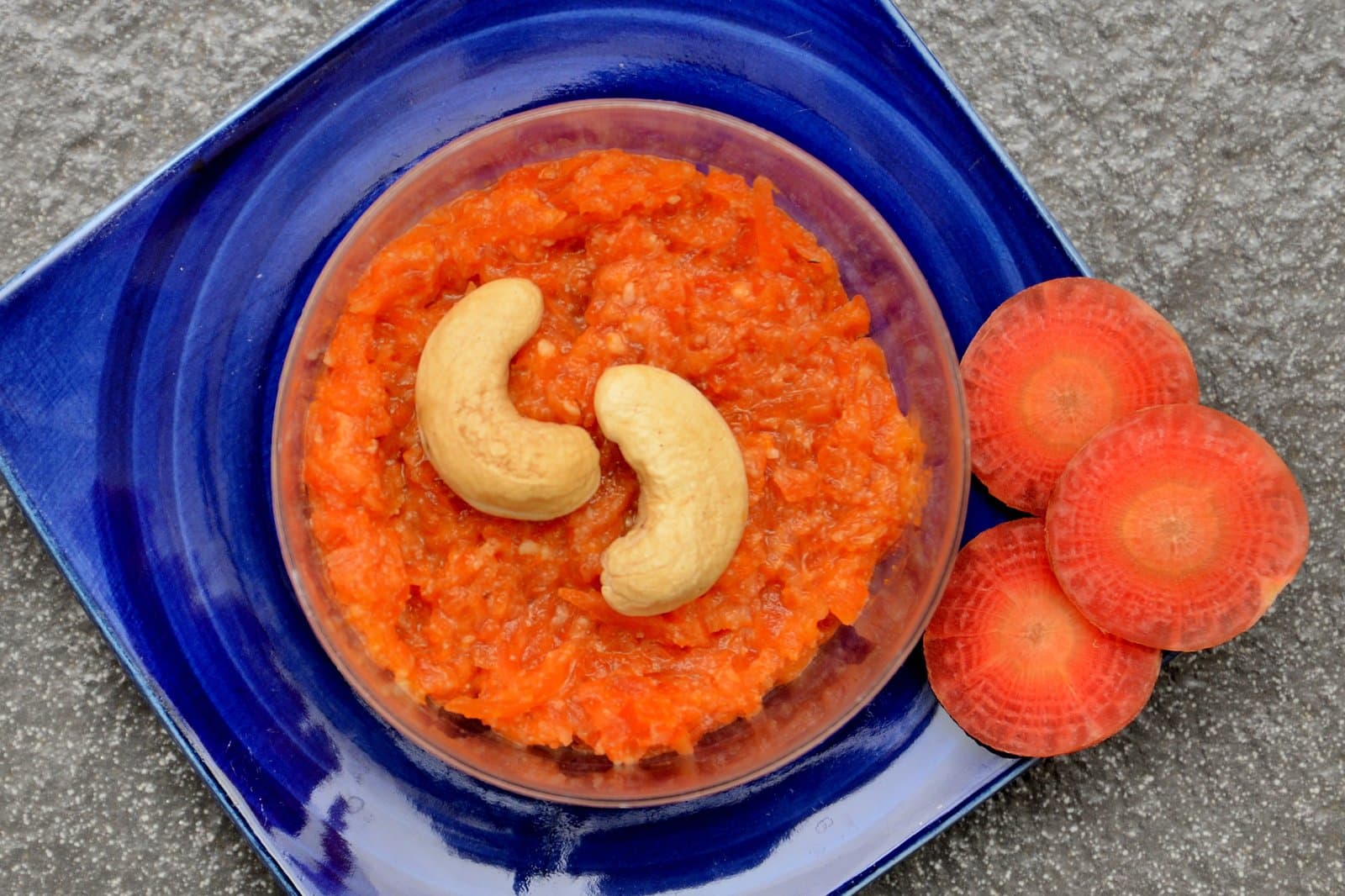
Short answer: a small bowl of gajar ka halwa, about 100 g, carries 150 to 320 calories. That range is the honest answer, because this dessert is basically carrots plus however much ghee, sugar, and khoya the cook felt like adding. A light homemade version sits near the bottom. A rich one from a sweet shop, heavy on khoya, sits near the top.
The numbers are anchored in published entries. A ghee-heavy homemade recipe with 4 tablespoons of ghee and added khoya lists 275.6 kcal per 100 g (Clearcals). A database entry lands at 260 per 100 g (hitungkalori). A commercial packed version lists 312.1 per 100 g (bigbasket). And lighter low-fat recipes come in at 114 to 166 per 100 g (recipeofhealth, recipeofhealth). Put together, 150 to 320 per 100 g covers the real world.
What moves the number
Ghee first. A tablespoon of ghee is about 120 kcal on its own. Recipes range from a spoon or two to half a cup for a big batch, and that single choice moves the per-100 g number by 50 to 100 kcal. When you see gajar halwa glistening, you are looking at calories.
Khoya second. Khoya is concentrated milk solids, dense in fat and protein. The Clearcals recipe adds 75 g of khoya and lands at 276 per 100 g. Skip it and use a little extra milk instead, and the number drops noticeably.
Sugar third. Most recipes run 100 to 150 g of sugar per half kilo of carrots. That is the carbohydrate column. The commercial version's 40.2 g of carbs per 100 g, with 20.4 g of sugar, tells you how sweet the rich versions get.
Then portion. A small bowl at home is 100 g. At a wedding or a restaurant, the bowl is often 200 g. Double the bowl, double the calories. This matters more than the recipe.
Gajar ka halwa calories and macros
| Gajar ka halwa | Portion | Calories | Protein | Carbs | Fat |
|---|---|---|---|---|---|
| Light homemade, less ghee, no khoya | 100 g | 150 to 180 | 2 to 3 g | 22 to 28 g | 6 to 9 g |
| Typical homemade | 1 small bowl (~100 g) | 240 to 280 | 4 to 5 g | 28 to 35 g | 12 to 16 g |
| Typical homemade | 1 large bowl (~200 g) | 480 to 560 | 8 to 10 g | 56 to 70 g | 24 to 32 g |
| Rich sweet shop style, with khoya | 100 g | 300 to 330 | 5 to 7 g | 35 to 42 g | 13 to 17 g |
Sugar sits at 20 to 30 g per 100 g in the typical rows, mostly added sugar. Fiber runs about 2 to 2.5 g per 100 g from the carrots, which is the one redeeming structural feature of the dish.
How to track it in seconds
In CalsFlow, type:
"1 bowl gajar ka halwa, homemade, medium ghee"
You get the calorie and macro estimate plus the assumptions: the bowl weight it guessed, the ghee it allowed for, whether it assumed khoya. Had the rich sweet shop version with khoya? Say so, and the number moves up with it. Had your mother's light version? Say "light on ghee, no khoya" and it drops.
This is the same honest-entry approach as our guide to counting calories in Pakistani and desi food: describe what is actually in front of you, check the assumptions, fix what is wrong.
Is gajar ka halwa healthy
It is a dessert. The WHO recommends keeping free sugars under 10% of daily energy intake (WHO), and one 100 g bowl of typical gajar halwa can carry 20 to 30 g of sugar, which eats a big chunk of that for most people. The saturated fat from the ghee is the other honest cost; we break ghee down properly in our desi ghee calories post.
The carrot side is real, though. Carrots are a strong source of beta carotene, which the body converts into vitamin A for vision and immune function (NIH). That does not cancel the sugar. It just means gajar ka halwa is not empty calories in the way a candy is. Dessert with a vitamin in it is still dessert.
FAQs
How many calories are in one bowl of gajar ka halwa? A small home bowl of about 100 g carries 240 to 280 kcal for a typical homemade recipe. A rich sweet shop version of the same bowl runs 300 to 330. A big 200 g restaurant bowl can pass 500.
Is gajar ka halwa good for weight loss? Not really, but it is one of the more honest desserts. A small 100 g bowl at 240 to 280 kcal can fit a cutting day if the rest of the day is light, which is the whole point of our daily calorie guide. The problem is never the bowl you planned. It is the second bowl.
Gajar ka halwa vs gulab jamun: which has fewer calories? Gajar ka halwa, slightly. Per 100 g it runs 150 to 320 against gulab jamun's 300 to 430, because gulab jamun is deep fried and soaked in syrup. Two gulab jamuns and a small bowl of gajar halwa land in the same neighborhood, around 250 to 300 kcal. Our gulab jamun calories breakdown has the full comparison.
Does gajar ka halwa have protein? Some: 4 to 7 g per 100 g from the milk and khoya. Not enough to count as a protein source. Our protein guide covers what actually counts.
The bottom line
Gajar ka halwa: 150 to 320 kcal per 100 g, with ghee, khoya, and bowl size deciding where you land. Say the ghee and the khoya when you log it and your numbers stay honest. Eating it this weekend? Describe it in CalsFlow with the ghee spelled out and get your real number.
Cover photo: Sharvarism via Wikimedia Commons (CC BY-SA 4.0).
CalsFlow provides nutrition estimates, not medical advice.