

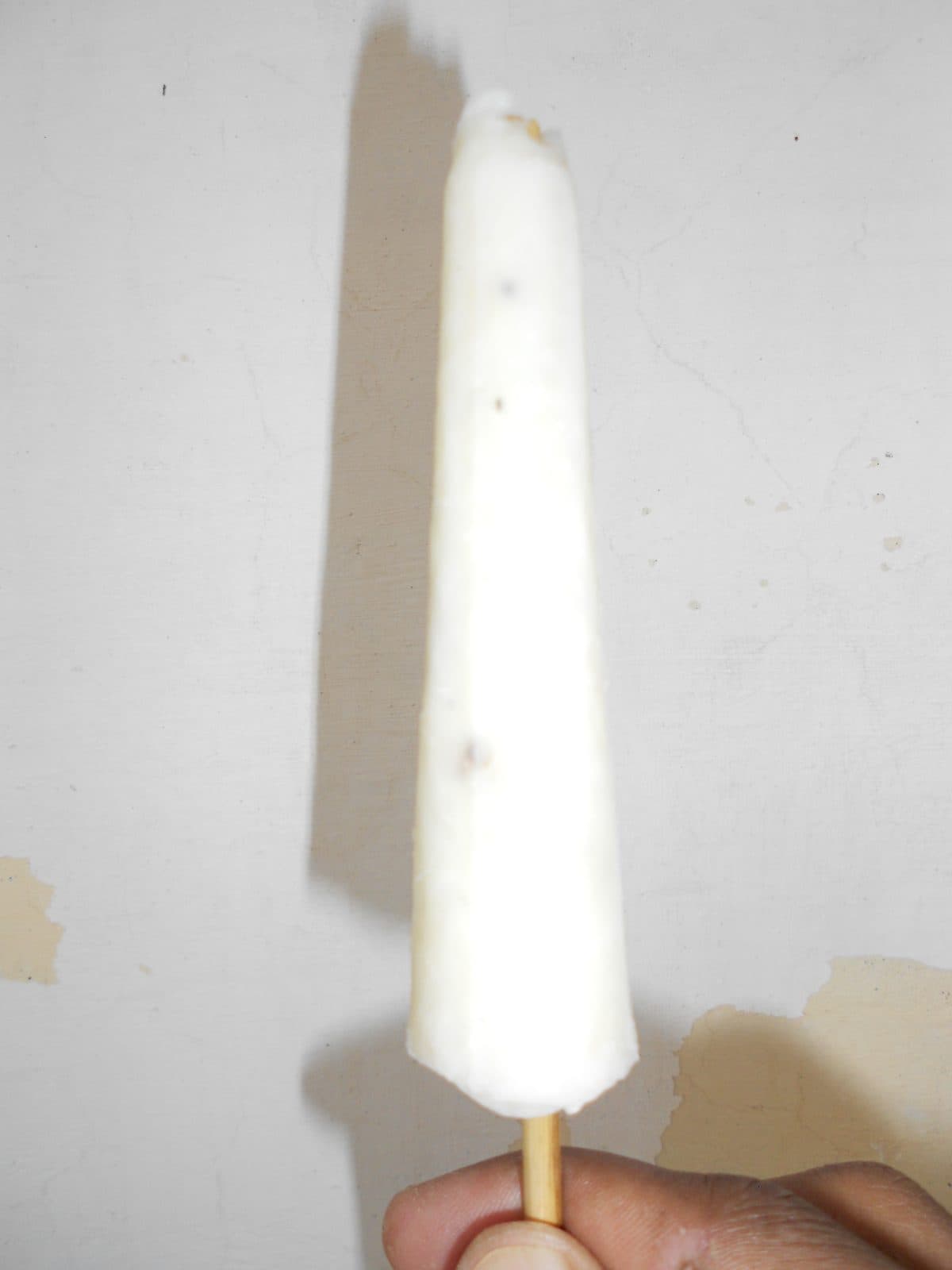
Short answer: one malai kulfi stick runs about 180 to 280 calories. Per 100 g, malai kulfi sits around 220 to 280 kcal. That is heavier than regular ice cream, and the reason is simple. Kulfi is milk simmered down slowly until it thickens, sweetened, then frozen without churning. No air gets whipped in, so every bite packs more milk solids and sugar than a scoop of vanilla ice cream.
Why kulfi costs more than ice cream
Regular ice cream is churned, and churning folds air into it. That air takes up space without adding calories. Kulfi skips that step entirely. The milk is reduced to roughly half its volume first, which concentrates the fat, the milk sugar and the protein, and then sugar and flavourings go in on top. The result is dense, slow to melt, and rich in a way that a soft scoop never is.
That density is also why the stick size matters so much. A slim street vendor stick might weigh 70 to 80 g. A thick packaged bar or a matka serving can weigh 120 g or more. Same dessert, very different totals, which is why the ranges below are given both per stick and per 100 g.
Calories and macros
| Food | Portion | Calories | Protein | Carbs | Fat |
|---|---|---|---|---|---|
| Malai kulfi, street stick | 1 stick (about 80 g) | 180 to 220 kcal | 4 to 6 g | 22 to 28 g | 8 to 11 g |
| Malai kulfi, large stick or bar | 1 stick (about 120 g) | 260 to 340 kcal | 6 to 9 g | 32 to 42 g | 12 to 17 g |
| Malai kulfi | 100 g | 220 to 280 kcal | 5 to 7 g | 27 to 35 g | 10 to 14 g |
| Pista kulfi | 100 g | 240 to 300 kcal | 6 to 8 g | 26 to 34 g | 13 to 17 g |
| Mango kulfi | 100 g | 230 to 290 kcal | 4 to 6 g | 30 to 38 g | 9 to 13 g |
| Matka kulfi, with rabri | 1 matka (about 150 g) | 350 to 480 kcal | 8 to 11 g | 45 to 60 g | 15 to 21 g |
| Kulfi falooda | 1 glass (about 350 g) | 500 to 700 kcal | 9 to 13 g | 70 to 95 g | 14 to 20 g |
| Light homemade kulfi | 100 g | 130 to 170 kcal | 5 to 7 g | 18 to 24 g | 4 to 6 g |
Sugar does most of the work in these numbers. A 100 g serving of malai kulfi carries roughly 22 to 30 g of sugar, and a mango kulfi a little more, since the fruit pulp adds its own sugars on top of the added kind. For context, the WHO guidance on free sugars is to keep them under 10 percent of daily energy, and ideally under 5 percent. One large kulfi stick can use up a big chunk of that on its own.
How the flavours compare
Malai is the baseline. It is just reduced milk, sugar, cardamom and sometimes a little cream, so its calories come almost entirely from milk fat and sugar. Pista kulfi runs a touch higher because pistachios and almonds add fat, though they also add a little protein and fibre, which is a fair trade for a dessert.
Mango kulfi looks lighter because it has fruit in it, but it usually is not. The pulp adds sugar, and shops often add extra sweetener to balance the tartness of the mangoes. Expect it to land in the same range as malai, sometimes a little above.
Matka kulfi is where the numbers jump. The kulfi itself is standard, but it is served in a clay pot with a layer of rabri, and sometimes falooda noodles and syrup underneath. That pot can hold 150 g or more before you count the toppings. If you want the matka experience without the full total, eat the kulfi and leave half the rabri.
Kulfi falooda is a different animal altogether. It is covered in full in the falooda post, but the short version is that a glass runs 500 to 700 calories, with the kulfi slice only one part of the total.
Is kulfi good for weight loss
It can fit, but it works better as a planned dessert than a daily habit. At 180 to 280 calories, a single stick is roughly the size of a small snack, and it does keep you full longer than most desserts because of the fat and protein from the milk. The problem is the sugar load and how easy it is to have a second stick, or a matka, or a kulfi falooda on top of a full dinner.
Two habits make it manageable. The first is picking the small stick over the large bar, which alone saves 80 to 120 calories. The second is eating it as the dessert itself, not after a heavy meal. A kulfi after biryani is a different evening from a kulfi as an evening snack.
Compared with other Pakistani desserts, kulfi sits in the middle. It is lighter per serving than a plate of gajar ka halwa and heavier than a bowl of kheer of the same weight, and it is far lighter than a royal falooda glass. If you are choosing between desserts, that ranking is worth knowing.
A lighter kulfi at home
Homemade kulfi is one of the easier desserts to lighten, because you control the two things that drive the calories: the milk and the sugar. Use low fat milk instead of full fat, cut the sugar by a third, and skip the cream. The texture stays dense because the slow reduction is what makes kulfi thick, not the fat alone. A light homemade version lands around 130 to 170 calories per 100 g, which is a genuine saving, and it still tastes like kulfi.
Frozen in small moulds or paper cups, the portions stay honest too. A small homemade kulfi runs about 100 to 140 calories, which is an easy dessert to fit into most days.
How to track kulfi without guessing
Here is where it gets practical. In CalsFlow, you would type:
"1 malai kulfi stick"
CalsFlow estimates the calories and macros, and shows its assumptions: the stick weight it guessed, whether it counted a street stick or a packaged bar, and how much sugar it allowed for. Had a matka kulfi with rabri? Say so, and the estimate jumps by 100 to 150 calories. Made the light version at home? Tell it low fat milk and less sugar, and watch the estimate drop. That editable assumption step is what turns a guess into a usable number.
Log a few kulfi outings this way and you will know your usual vendor's stick by heart. The point is not to stop eating kulfi. The point is to stop being surprised by it.
FAQs
How many calories are in 1 kulfi? About 180 to 280 kcal for a standard malai kulfi stick. A slim street stick is closer to 180, and a large packaged bar is closer to 280 or above.
How many calories are in 100 g of kulfi? Roughly 220 to 280 kcal for malai kulfi, 240 to 300 for pista, and 230 to 290 for mango.
Is kulfi healthier than ice cream? Not really. Kulfi has no artificial additives and is made from real milk, which counts for something, but it is denser and usually higher in calories and sugar per 100 g than regular ice cream. The health argument for kulfi is about ingredients, not calories.
Does kulfi have a lot of sugar? Yes. A 100 g serving carries roughly 22 to 30 g of sugar, most of it added. Mango kulfi runs a little higher.
Can I eat kulfi on a diet? Yes, as an occasional dessert. Pick the small stick, skip the matka and rabri, and count it as your dessert for the day rather than an extra on top of dinner.
The bottom line
Kulfi: 180 to 280 kcal for a standard stick, 220 to 280 per 100 g, 350 to 480 for a matka with rabri. It costs more than ice cream because it is denser, not because it is worse. Eating one tonight? Describe it in CalsFlow, check whether it counted a street stick or a large bar, and get your real number in seconds.
Sources: calorie and macro ranges are estimated from USDA FoodData Central values for whole milk (about 150 kcal per cup), vanilla ice cream (about 207 kcal per 100 g), granulated sugar and pistachios, adjusted for kulfi's reduced milk base, density and typical serving sizes. WHO guidance on free sugars: under 10 percent of daily energy, ideally under 5 percent.
Cover photo: Obaid Raza via Wikimedia Commons (CC BY-SA 4.0).
CalsFlow provides nutrition estimates, not medical advice.