

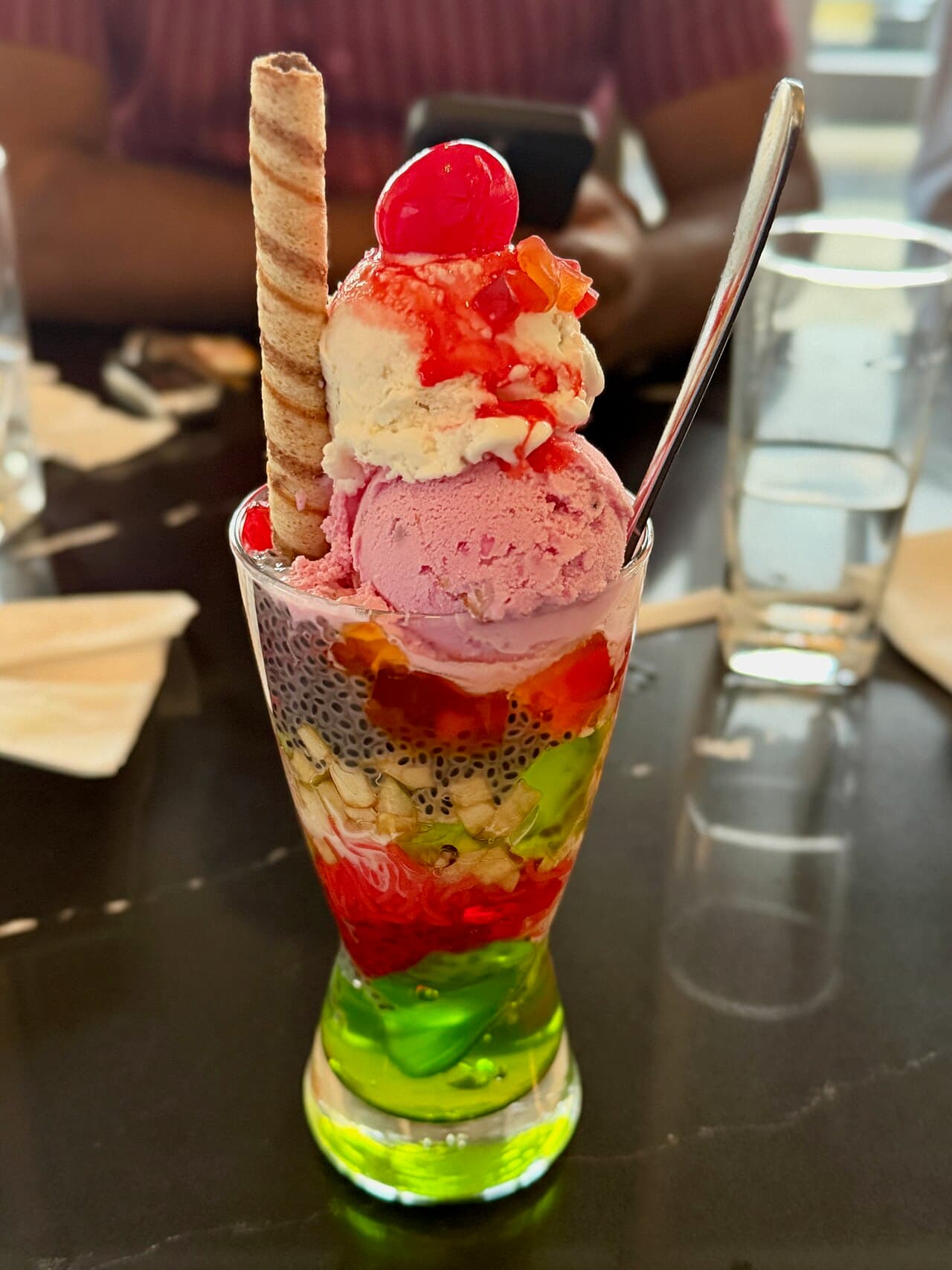
Short answer: a typical restaurant falooda glass runs about 450 to 650 calories. A royal falooda, loaded with kulfi, rabri and extra nuts, can push past 800. A lighter homemade glass, built with less syrup and one small scoop of ice cream, lands closer to 300 to 400. Falooda looks like a drink and eats like a dessert, which is exactly why the number surprises people.
What is actually in the glass
Falooda is not one thing. It is a stack of small things, and each layer adds its own calories. At the bottom sit soaked basil seeds and thin vermicelli noodles, usually with jelly cubes. Over those goes sweetened milk, often rose flavoured, then a scoop of ice cream or a slice of kulfi. The top gets rose syrup, chopped pistachios and almonds, sometimes a spoon of rabri, and a cherry if the shop is feeling generous.
None of these layers is extreme on its own. The total climbs because a falooda glass holds a lot of them at once. The milk alone is roughly a cup. Add a scoop of ice cream, two spoonfuls of syrup and a handful of nuts, and you have a small meal dressed up as a cold drink.
The basil seeds are the one layer that costs almost nothing. Soaked basil seeds add texture and a little fibre for roughly 10 to 20 calories. The vermicelli and jelly are modest too, around 80 to 100 and 30 to 50 respectively. The real weight comes from the sweet parts: the syrup, the ice cream or kulfi, and the rabri.
Calories and macros
| Food | Portion | Calories | Protein | Carbs | Fat |
|---|---|---|---|---|---|
| Falooda, standard restaurant glass | 1 glass (about 350 g) | 450 to 650 kcal | 8 to 12 g | 70 to 95 g | 12 to 18 g |
| Falooda, royal (kulfi plus rabri) | 1 large glass (about 450 g) | 650 to 850 kcal | 12 to 16 g | 90 to 120 g | 20 to 30 g |
| Falooda, light homemade | 1 glass (about 300 g) | 300 to 400 kcal | 6 to 9 g | 45 to 60 g | 6 to 10 g |
| Falooda, small takeaway cup | 1 small cup (about 200 g) | 280 to 380 kcal | 5 to 8 g | 40 to 55 g | 7 to 11 g |
| Kulfi falooda, street style | 1 glass (about 350 g) | 500 to 700 kcal | 9 to 13 g | 70 to 95 g | 14 to 20 g |
Per 100 g, a standard falooda sits around 130 to 185 kcal. That is lighter per gram than gulab jamun or gajar ka halwa, but a falooda serving is much bigger, so the glass total ends up in the same neighbourhood.
Sugar does most of the damage. A standard glass carries roughly 55 to 80 g of sugar, and a royal one can cross 100 g. That is several times the amount in a glass of lassi, and it is why falooda fills you up less than its calories suggest. Liquid sugar does not satisfy hunger the way food does, even when noodles and nuts are floating in it.
Why one glass can vary so much
Three choices decide where your glass lands in the range. The first is the topping. Kulfi is denser than regular ice cream because it is made from milk reduced down slowly, so a kulfi slice usually costs more than a scoop of vanilla ice cream. Rabri on top adds another 80 to 120 calories before you have touched the rest.
The second is the syrup. Rose syrup is essentially sugar water with flavour, and shops rarely measure it. Two tablespoons add around 80 to 120 calories. A generous pour can double that without changing how the glass looks.
The third is the size of the glass itself. A street vendor's small cup and a restaurant's tall royal glass can differ by 200 calories or more, even with the same ingredients. If you are tracking, the glass size matters as much as the recipe.
Homemade falooda is easier to control. Use low fat milk, one small scoop instead of two, a single measured spoon of syrup, and skip the rabri. Those four changes alone can take a 600 calorie glass down to around 350, and it still tastes like falooda.
Is falooda good for weight loss
It can fit into a weight loss plan, but it works better as an occasional dessert than a daily drink. At 450 to 650 calories, a standard glass is close to a full meal's worth of energy with very little protein to show for it. Protein is what keeps you full, and falooda gives you roughly 8 to 12 g against 70 g or more of carbs.
That does not mean giving it up. It means treating it like dessert. Share a royal glass, order the small cup, or make the light version at home. The WHO guidance on free sugars is a useful anchor here: keeping them under 10 percent of daily energy, and ideally under 5 percent, leaves room for a falooda now and then without it quietly becoming a daily habit.
If you eat falooda after a heavy dinner, the total for the evening can climb past 1,500 calories before you notice. Having it as the dessert itself, instead of on top of a full meal, is the simplest fix.
How to track falooda without guessing
Here is where it gets practical. In CalsFlow, you would type:
"1 royal falooda glass"
CalsFlow estimates the calories and macros, and shows its assumptions: the glass size it guessed, whether it counted kulfi or ice cream, and how much syrup it allowed for. Eating the light homemade version? Tell it one scoop, low fat milk and one spoon of syrup, and watch the estimate drop by 150 to 250 calories. That editable assumption step is what turns a guess into a usable number.
Log a few falooda outings this way and you will know your usual shop's glass by heart. The point is not to stop ordering falooda. The point is to stop being surprised by it.
FAQs
How many calories are in 1 glass of falooda? About 450 to 650 kcal for a standard restaurant glass. A royal falooda with kulfi and rabri runs 650 to 850, and a light homemade glass runs 300 to 400.
Does kulfi falooda have more calories than ice cream falooda? Usually, yes. Kulfi is made from reduced milk, so it is denser and richer than a scoop of regular ice cream. Expect a kulfi glass to sit 50 to 100 calories above the same glass topped with vanilla ice cream.
How much sugar is in falooda? Roughly 55 to 80 g in a standard glass, and over 100 g in a royal one. Most of it comes from the rose syrup and the sweetened milk, not from the fruit or nuts.
Is falooda healthier than other Pakistani desserts? Per serving it is comparable to kheer and lighter than a plate of gajar ka halwa, but the sugar load is still high. The basil seeds and nuts add a little fibre and healthy fat, which is more than most desserts offer, but not enough to make it a health food.
Can I make a low calorie falooda at home? Yes. Low fat milk, one small scoop of light ice cream, one measured spoon of syrup, plenty of basil seeds and jelly, and no rabri gets you to roughly 300 to 350 calories. It keeps the texture and the rose flavour, which are the parts people actually miss.
The bottom line
Falooda: 450 to 650 kcal for a standard glass, 650 to 850 for a royal one, 300 to 400 for a light homemade version. The milk and the ice cream set the base, the syrup and the rabri set the ceiling, and the glass size decides where you land. Ordering falooda tonight? Describe it in CalsFlow, check whether it counted kulfi or ice cream, and get your real number in seconds.
Sources: calorie and macro ranges are estimated from USDA FoodData Central values for whole milk (about 150 kcal per cup), vanilla ice cream (about 207 kcal per 100 g), granulated sugar and mixed nuts, adjusted for typical falooda layers and serving sizes.
Cover photo: Oleg Yunakov via Wikimedia Commons (CC BY-SA 4.0).
CalsFlow provides nutrition estimates, not medical advice.