

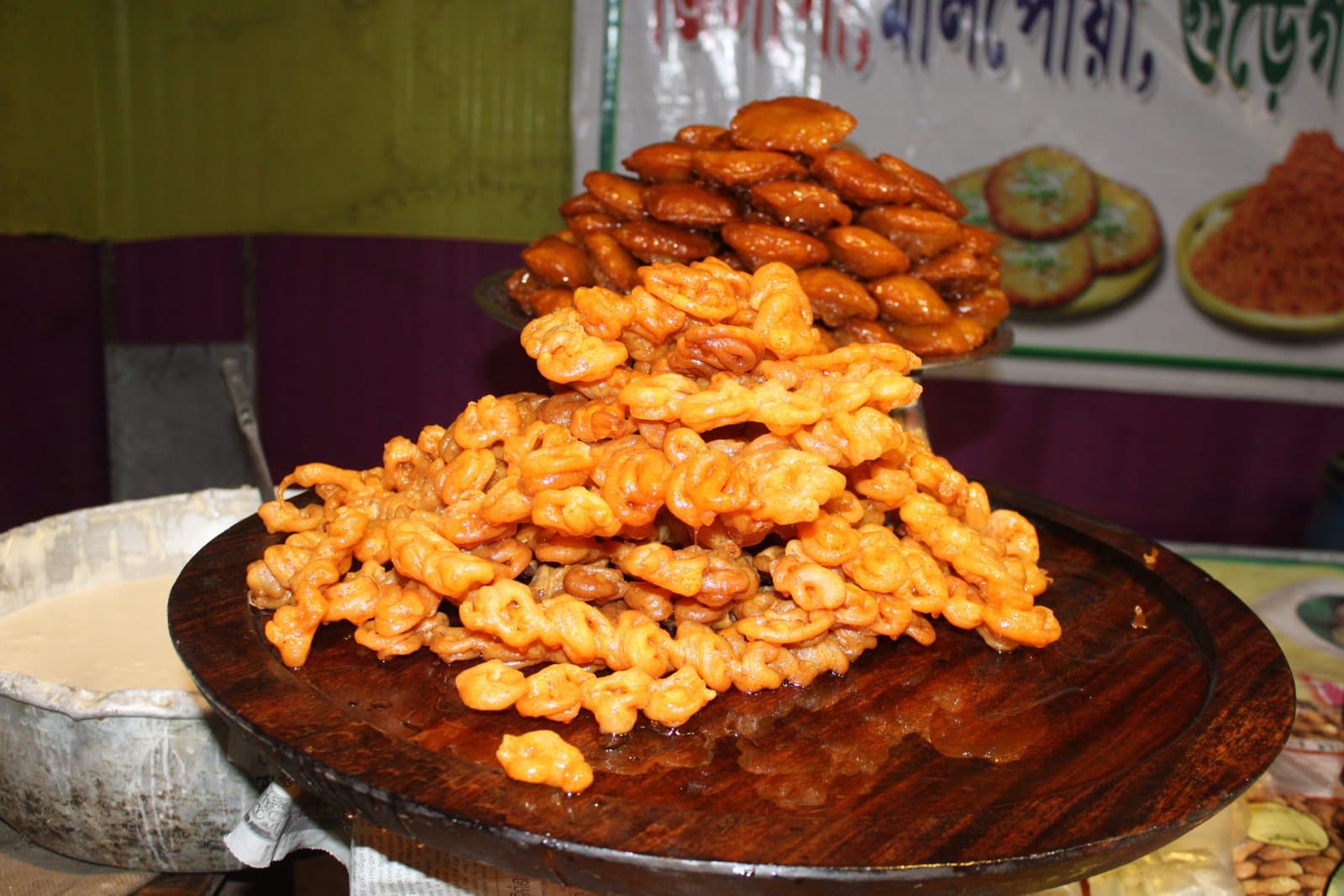
One jalebi usually lands between 100 and 170 calories, and 100 grams sits somewhere around 300 to 400. The spread is wide because a jalebi is not really a fixed food. It is a fried coil of batter whose final weight depends on how much sugar syrup it drank before it reached you.
That coil shape is the whole story. The batter itself is light: refined flour, a little yogurt, fermented overnight for that slight tang. Then it goes into hot ghee or oil and comes out as crisp spirals. The syrup, chashni, does the heavy lifting. Most published nutrition estimates put jalebi at roughly 45 to 60 grams of carbs per 100 grams, and most of that is sugar from the soak, not the flour.
What one jalebi actually contains
A fresh jalebi from a halwai weighs anywhere from 30 to 60 grams, and that alone doubles the count. Then comes the syrup. A jalebi lifted out quickly and drained lands low. One left sitting in a warm pot of chashni through a whole evening drinks in far more. Frying matters too: coils fried in desi ghee carry more fat than ones fried in vegetable oil, though at the dhaba both come out of the same kadhai and you will never know which one you got.
| Portion | Calories | Protein | Carbs | Fat |
|---|---|---|---|---|
| 1 small piece (about 30 g) | 90 to 120 | 1 g | 14 to 18 g | 4 to 6 g |
| 1 typical piece (about 55 g) | 140 to 180 | 2 g | 25 to 33 g | 7 to 11 g |
| 1 large piece (about 80 g) | 200 to 270 | 2 to 3 g | 36 to 48 g | 10 to 16 g |
| 100 g (reference) | 300 to 400 | 3 to 4 g | 45 to 60 g | 13 to 20 g |
| 2 typical pieces | 280 to 360 | 3 to 4 g | 50 to 65 g | 15 to 22 g |
The protein column tells its own story. There is almost none. A jalebi is sugar, starch, and frying fat, which means it fills you for about as long as the sweetness lasts on your tongue.
Why your count and mine never match
Size is the obvious lever. Halwais shape them differently everywhere: thin tight coils at some shops, thick chunky ones at others. If you log "1 jalebi" without noting the size, you can be off by double.
Syrup thickness is the sneaky one. A thin chashni adds less sugar than a thick reduced one, and warm jalebis served straight from the pot hold more syrup than cooled ones that have been sitting on a tray. In Ramadan, when jalebi appears at every iftar table, the batches are made fast and soaked fast, and those tend to run heavier than the carefully drained ones from a good mithai shop.
Then there is the classic pairing. Doodh jalebi, coils served with cold rabri or milk, is one of the great Pakistani desserts, and it adds the milk on top of the numbers above. A cup of rabri can add another 150 to 250 calories. The kheer calories post covers what milk desserts carry on their own.
Logging it in CalsFlow the right way
Jalebi is a good test of how you log desi sweets. Type in something like "2 fresh jalebi from the halwai, medium size". CalsFlow starts with an average assumption, somewhere around 150 calories a piece. Then you adjust. Were they the thin ones or the thick ones? Drained or dripping? With rabri or on their own? Dial the portion and the estimate moves into the right range.
That adjust step is what separates a useful log from a fantasy one. No fixed database has your halwai's exact jalebi.
A note on sugar
The WHO recommends keeping free sugars below 10% of total energy intake, which works out to under 50 grams a day on a 2,000 calorie diet. A single large jalebi can carry 25 grams of sugar, half that budget in a few bites. This is a refined flour sweet soaked in syrup, so blood sugar rises fast after eating it.
That does not mean you can never touch it. It means the sweet tray is where small counts matter most. For people with diabetes, jalebi is one of the foods to treat with the most caution, and it is worth checking with a doctor or dietitian about whether it fits at all.
Making it work in a normal week
You do not need to give up mithai to stay on track. A few habits do the work.
Buy fresh from the halwai instead of grabbing from an open box at home, where pieces keep disappearing without being counted. If you know jalebi is coming at iftar or after dinner, eat the main meal a little lighter. And when you are served warm jalebi straight from the kadhai, let it rest a minute so excess syrup drains. It is still sweet. It is just a little less of it.
Jalebi has relatives worth knowing. Imarti, also called amritti, looks similar but is made from urad daal batter with thicker coils, and it lands in roughly the same calorie range. Kesar jalebi is the same sweet with saffron in the syrup, no meaningful calorie difference.
If you are comparing across the sweet shelf, gulab jamun calories covers jalebi's closest rival at the mithai shop, the Pakistani food calorie chart puts both alongside the rest of the usual suspects, and Pakistani chai calories covers what usually arrives next to the plate.
Frequently asked questions
Is jalebi good for weight loss? Not particularly. It is almost pure sugar and fat with no protein to keep you full, so it is the kind of food that is easy to overeat. One piece as an occasional treat fits most plans. The box on the counter is the problem.
How many calories are in 2 jalebis? Roughly 280 to 360 for two typical pieces, depending on size and syrup. Two large, heavily soaked ones can push past 400.
Can diabetics eat jalebi? Very rarely, in tiny portions, and ideally with a doctor's guidance. It is refined flour plus a sugar syrup soak, one of the fastest blood sugar spikes in the Pakistani dessert lineup.
What is the difference between jalebi and imarti? Jalebi uses a wheat flour batter piped into thin coils. Imarti uses urad daal batter and comes out thicker and chewier. Both are deep fried and soaked in syrup, so their calories sit in the same range.
If you are tracking tonight's jalebi, describe it in CalsFlow: how many pieces, the size, and how syrupy they were. Adjust from there and you will have a number you can actually trust.
Cover photo: Jalebi at a food stall by Raju Alam via the WordPress Photo Directory (CC0). CalsFlow provides nutrition estimates, not medical advice.