

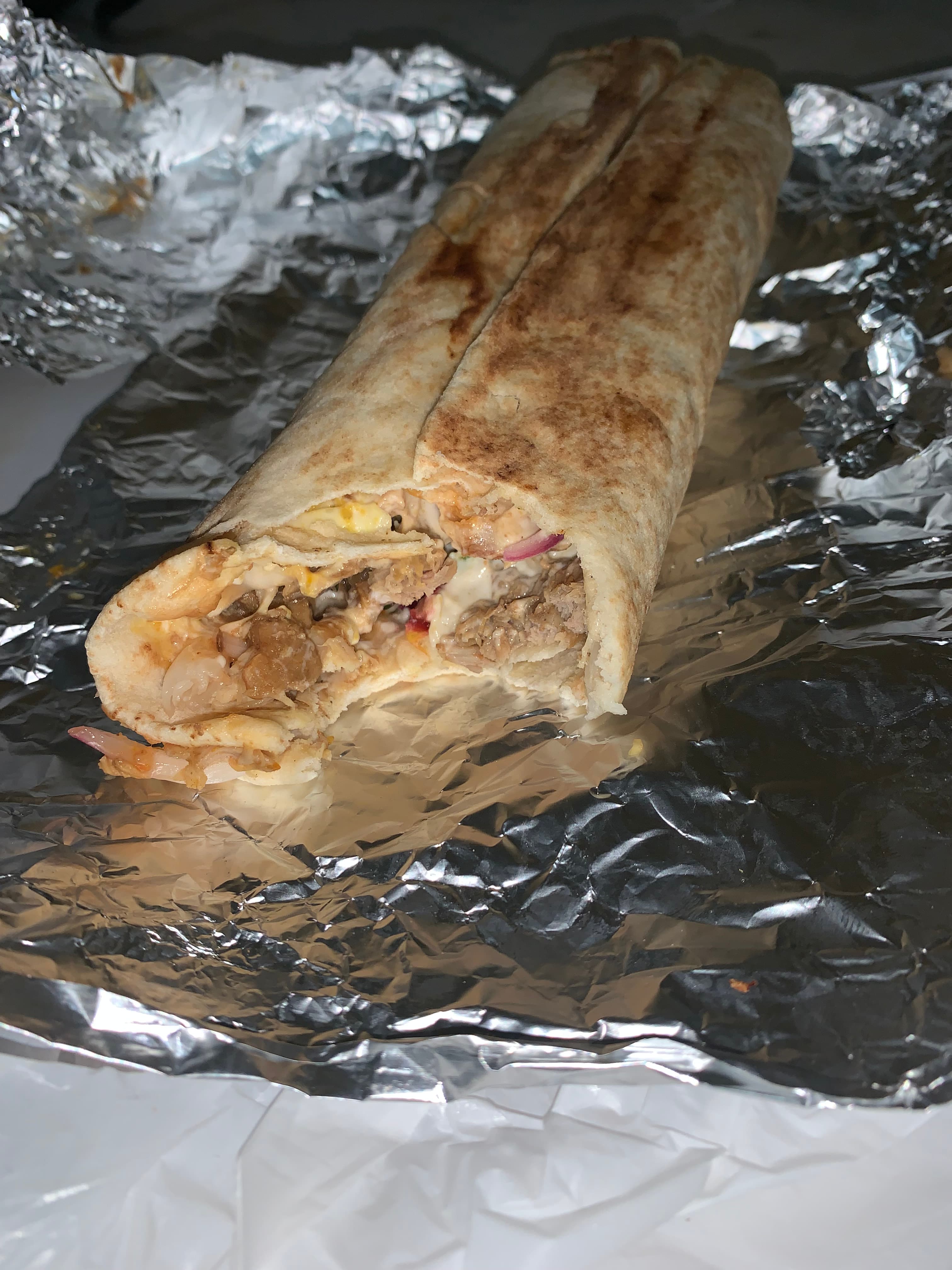
A regular chicken shawarma wrap weighs about 200 to 220 grams and lands between 400 and 550 calories. Per 100 grams, a shawarma wrap sits around 200 to 220 calories. The wide range is real, because a shawarma is four separate calorie decisions stacked in one piece of khubus: the bread, the chicken, the sauce, and whatever goes in with it.
Shawarma is Pakistan's great late night equalizer. Students, rickshaw drivers, office workers, everyone lines up at the same counter at midnight. It looks like a snack and it costs like a snack, so people log it like a snack. A loaded one with fries inside can push past 700 calories. That is not a snack. That is dinner.
What a Pakistani shawarma actually contains
Chicken cut off the vertical spit, usually thigh meat, which is richer and more flavorful than breast. Khubus, the soft pocket bread that holds it all. Garlic sauce, which in Pakistan is most often garlic mayonnaise rather than the lighter toum. Pickled cucumbers or a simple salad. And at many stalls, a handful of fries stuffed inside the wrap, which has quietly become the default in a lot of cities.
Each piece moves the number on its own. The bread contributes roughly 200 to 250 calories. The chicken adds 150 to 220 depending on the cut and how generous the scoop is. Garlic sauce is the sneaky one: mayonnaise based sauces run about 60 calories per tablespoon, and the vendor's spoon is not a measuring spoon. Two extra spoons of sauce can add 120 calories without changing how big the wrap looks.
Here are realistic ranges, built by scaling published per 100g nutrition estimates from food databases to Pakistani street portions.
| Portion | Calories | Protein | Carbs | Fat |
|---|---|---|---|---|
| Per 100 g (wrap) | 200 to 220 | 9 to 11 g | 18 to 22 g | 9 to 12 g |
| Small wrap (~150 g) | 280 to 380 | 13 to 18 g | 26 to 34 g | 12 to 18 g |
| Regular wrap (~210 g) | 400 to 550 | 20 to 28 g | 36 to 48 g | 18 to 28 g |
| Large wrap with fries (~300 g) | 620 to 820 | 28 to 36 g | 55 to 70 g | 28 to 40 g |
| Shawarma fries plate (~350 g) | 700 to 950 | 24 to 32 g | 60 to 75 g | 34 to 48 g |
| Open plate, chicken and salad, no bread (~250 g) | 320 to 450 | 30 to 40 g | 6 to 12 g | 16 to 26 g |
The protein column is the good news. Chicken shawarma meat itself is high protein, around 20 to 26 grams per 100 grams. A regular wrap quietly delivers 20 to 28 grams, which is more than most people expect from fast food.
Why one wrap is never like the next
Sauce count is the biggest variable. A dry wrap with one spoon of garlic sauce and a double sauced one can be 150 calories apart. Nobody at the counter is measuring, so the honest approach is to assume two to three spoons of sauce on a standard wrap.
The fries question matters more than it looks. Some stalls add a handful inside by default, some ask, some charge extra. A modest handful of fries adds 120 to 180 calories. If your wrap felt heavy and stayed hot a long time, there were probably fries in it.
Then there is the meat. Spit chicken varies between shops: thigh meat carries more fat than breast, and the crispy browned edges from the rotisserie pick up rendered fat. A leaner stall that mostly serves breast cuts will sit at the bottom of the range.
This is why a single fixed database number fails on shawarma. "Chicken shawarma: 412 calories" describes one specific wrap from one specific counter, not yours. Ranges are the honest answer.
Logging it in CalsFlow the right way
Shawarma is a perfect case for describing your meal instead of picking a database entry. Type in something like "one regular chicken shawarma wrap, garlic sauce, fries inside". CalsFlow starts with an average assumption, roughly 480 calories for that description. Then you adjust. Was it a small one from the neighborhood stall, or a big loaded wrap? Single sauce or double? Fries or no fries?
The sauce and fries answers are the two that matter most. Get those two right and the estimate lands close to reality. Skip them and the range doubles. This is the step where most food logging goes wrong with street food: people log the bread and the chicken and forget the two calorie bombs hiding inside.
A note on fat and sodium
Shawarma runs higher in fat and sodium than it looks. The garlic mayo, the spit rendered chicken fat, and the fries are all fat sources, and cured pickles plus seasoned chicken push the sodium up. The WHO recommends keeping saturated fat below 10% of total energy intake, and a large loaded wrap can use up a large share of that on its own.
That does not make shawarma a forbidden food. It makes it a food worth counting honestly. A regular wrap with one sauce and no fries is a reasonable 400 to 500 calorie meal with solid protein. The danger is the large double sauced version with fries logged as 400 calories when it is closer to 800.
If you are comparing across the fast food row, the Pakistani food calorie chart puts shawarma next to bun kebab, chapli kebab, and seekh kebab, and bun kebab calories covers the other midnight classic. For the protein angle, what are macros explains where that 25 grams of protein actually comes from.
Frequently asked questions
Is chicken shawarma good for weight loss? A regular wrap fits a weight loss plan fine, especially with one sauce and no fries. The protein keeps you full. The large loaded versions are the ones that quietly blow a deficit.
How many calories are in one chicken shawarma wrap? About 400 to 550 for a regular 210 gram wrap. Small wraps run 280 to 380, and large ones with fries reach 620 to 820.
Is shawarma healthier than a burger? Often yes, mostly because of the protein. A regular chicken shawarma wrap carries more protein and less processed filler than a typical fast food burger, but a heavily sauced large wrap with fries is in the same calorie territory.
Can I eat shawarma if I am tracking calories? Absolutely. It is one of the easier street foods to track because the components are simple. Describe the size, the sauce, and the fries, and the estimate lands close.
Having shawarma tonight? Describe it in CalsFlow: regular or large, single or double sauce, fries inside or not. Adjust from there and you will have a number you can actually trust.
Cover photo: Chicken Sharwama by Umuhiera via Wikimedia Commons (CC0 1.0). CalsFlow provides nutrition estimates, not medical advice.