

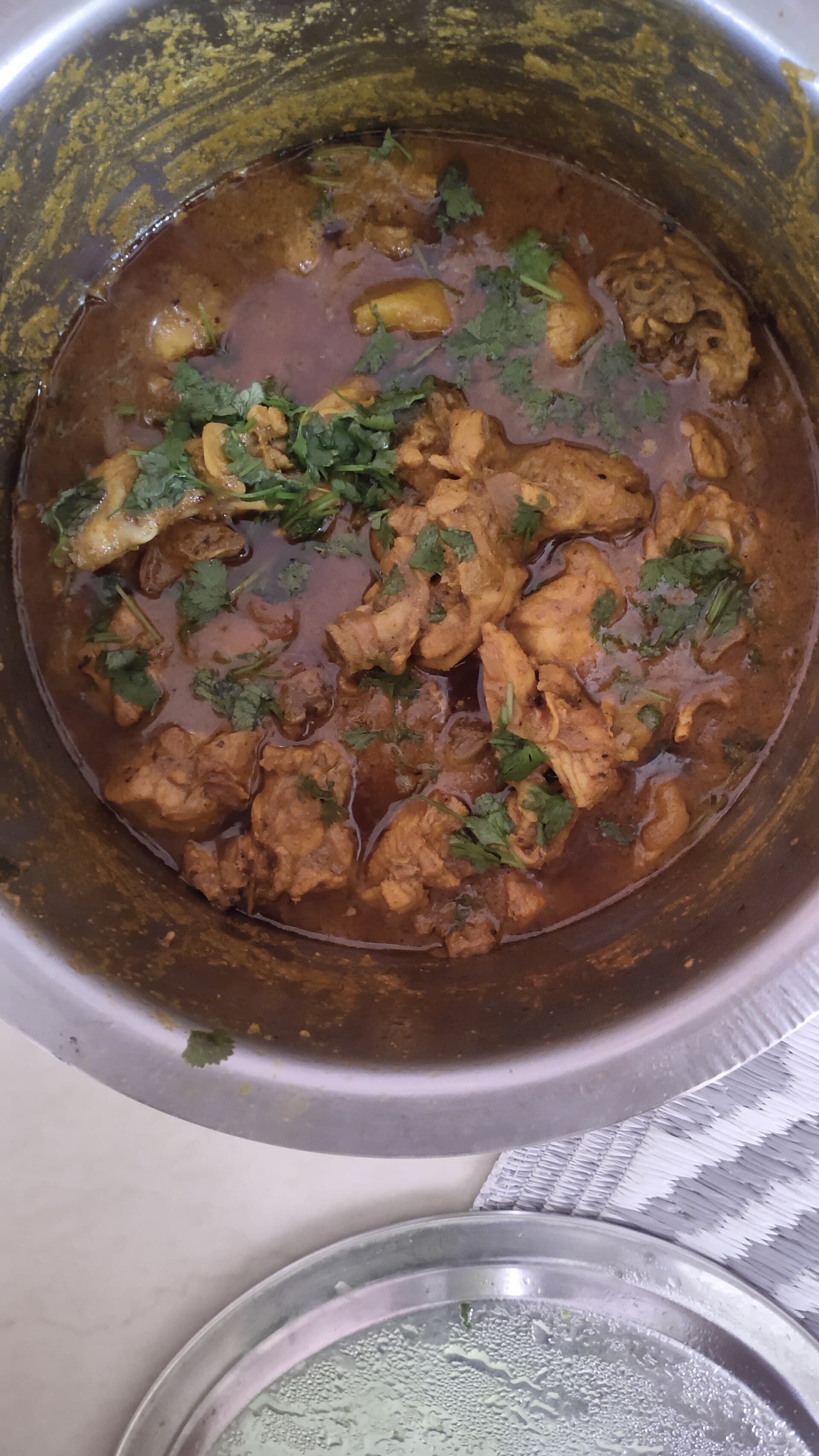
Short answer: a cup of homemade chicken curry, about 240 g, has 260 to 360 calories. The same curry from a dhaba or restaurant, served as a roughly 300 g plate, runs 500 to 700 calories. Per 100 g, a light home version sits around 110 to 150 kcal. The gap is not the chicken. It is the oil in the gravy, whether the chicken still has its skin, and how much gravy lands on the plate.
In most Pakistani homes this dish is just called chicken salan. It is the everyday curry, onion and tomato cooked down into a masala, chicken simmered in it until tender, finished with green chillies and coriander. It is not karahi, which is cooked fast on high heat with tomatoes and ginger, and it is not qorma, which leans on yoghurt and browned onion for a richer gravy. Salan is the one that shows up on a Tuesday night with roti, and because every home makes it a little differently, no single number fits all of them.
What decides the number
The oil. This is the biggest lever by far. A tablespoon of oil or ghee carries roughly 120 calories, and it disappears into the gravy where you cannot see it. A home cook who starts with two tablespoons for a whole pot is spreading a modest amount across four or five servings. A dhaba cook who is generous with the tarka, or who lets the curry sit so the oil rises to the top, can easily double that. If the surface of your curry shines and oil pools at the edge of the plate, log the top of the range.
Skin on or off, bone in or boneless. Skinless chicken breast is lean, and published nutrition data from the USDA FoodData Central puts cooked chicken breast around 165 calories per 100 g with about 31 g of protein. Chicken cooked on the bone with the skin still on carries more fat, and the fat from the skin ends up in the gravy. Boneless breast gives the lightest result. Bone in pieces with skin give a richer one, and most home salan is made that way.
How much gravy you actually eat. People count the chicken pieces and forget the gravy, but the gravy is where the oil lives. A serving that is mostly chicken with a couple of spoonfuls of gravy is a different meal from a plate swimming in it. When you log salan, the gravy matters at least as much as the number of pieces.
Potatoes. Plenty of homes throw a few potatoes into the pot to stretch the curry. A potato adds carbs, roughly 75 to 90 calories per 100 g cooked, and it soaks up gravy as well. It does not ruin the dish, but a cup with potatoes sits higher on carbs than a cup without.
Yoghurt or cream. Some recipes finish with a spoon of yoghurt, which adds very little. A restaurant version finished with cream is another story. Cream adds fat fast, and it is one reason restaurant curries land so much higher than home ones.
Chicken curry calories and macros
| Food | Portion | Calories | Protein | Carbs | Fat |
|---|---|---|---|---|---|
| Homemade, light oil, boneless | 1 cup (240 g) | 260 to 360 | 28 to 35 g | 6 to 10 g | 11 to 18 g |
| Homemade, bone in, regular oil | 1 cup (240 g) | 340 to 460 | 24 to 32 g | 7 to 12 g | 20 to 30 g |
| Homemade, with potatoes | 1 cup (240 g) | 320 to 450 | 24 to 31 g | 15 to 22 g | 18 to 28 g |
| Restaurant or dhaba | 1 plate (about 300 g) | 500 to 700 | 30 to 40 g | 10 to 16 g | 30 to 45 g |
| Homemade, light oil | 100 g | 110 to 150 | 12 to 15 g | 3 to 4 g | 5 to 8 g |
| Restaurant or dhaba | 100 g | 170 to 230 | 10 to 13 g | 3 to 5 g | 10 to 15 g |
These are ranges because a salan has no standard recipe. The same pot can come out lighter or heavier depending on the cook's hand with the oil bottle. The protein stays strong across all versions, which is the good news. Chicken salan is a genuinely protein rich meal, even at the oily end.
Logging it in CalsFlow
Salan is easy to underlog because people write "chicken" and stop there. Say you had a home cup, bone in, with a normal amount of oil and two rotis on the side. In CalsFlow you could enter "1 cup homemade chicken salan, bone in, regular oil, plus 2 rotis". CalsFlow would assume a 240 g cup with gravy and return something around 340 to 460 calories for the curry alone, then add the rotis as a separate line. If your cup was mostly gravy with little chicken, say so, and the estimate adjusts down on protein and up on fat. If it was a dhaba plate, name the dhaba version, because that oily gravy is a different food from the home pot in calorie terms.
The same habit works across the rest of a Pakistani meal. The Pakistani food calorie chart covers the usual plates and sides, roti calories covers the bread on the side, and counting calories in Pakistani and desi food explains how to estimate portions for dishes that never come with a label. If you want to compare salan with its richer cousins, see chicken karahi calories and chicken qorma calories.
Is chicken curry good for weight loss?
The home version, yes, with one condition. It is high in protein, it pairs naturally with roti or a small portion of rice, and it is filling in a way a light snack never is. The condition is the oil. A light home salan fits a calorie deficit comfortably. A dhaba plate, especially with extra gravy mopped up with naan, can quietly use up half a day's deficit in one meal, and the WHO healthy diet guidance is a useful reminder that a large share of daily fat often hides in cooking oil and rich gravies rather than in the main ingredient itself.
Salt is the other thing worth watching. Restaurant and dhaba curries tend to be salted heavily, and a very salty plate plus pickles and raita can push sodium well past what a home pot would carry. That does not change the calories, but it is part of why the home version is the better everyday choice.
For the bigger picture on how much you actually need in a day, see how many calories you should eat per day, and for what the protein, carb, and fat numbers mean, see what macros are.
FAQs
Is chicken salan the same as chicken curry? In Pakistan, yes for practical purposes. Salan is the local word for the home style curry with gravy. When a recipe site says chicken curry, it usually means the same kind of dish, though restaurant versions abroad can be sweeter or creamier than a Pakistani home salan.
How many calories are in chicken curry with rice? Add the rice to the curry. A cup of cooked rice adds roughly 200 to 240 calories, so a home cup of salan with a cup of rice lands around 460 to 600 calories before any raita or salad.
Does chicken curry have a lot of protein? Yes. A cup gives roughly 24 to 35 g of protein depending on the cut and how much chicken is in it. That is a solid portion of a day's protein in a single serving, which is why salan works well as the main meal of the day.
Next time salan is on the stove, describe it in CalsFlow with the cut, the oil, and whether there are potatoes in the pot, and let it sort out the range. Try it on the CalsFlow app.
Cover photo: Homemade chicken curry by Medhi jyoti, Wikimedia Commons, CC BY 4.0.
CalsFlow provides nutrition estimates, not medical advice.