

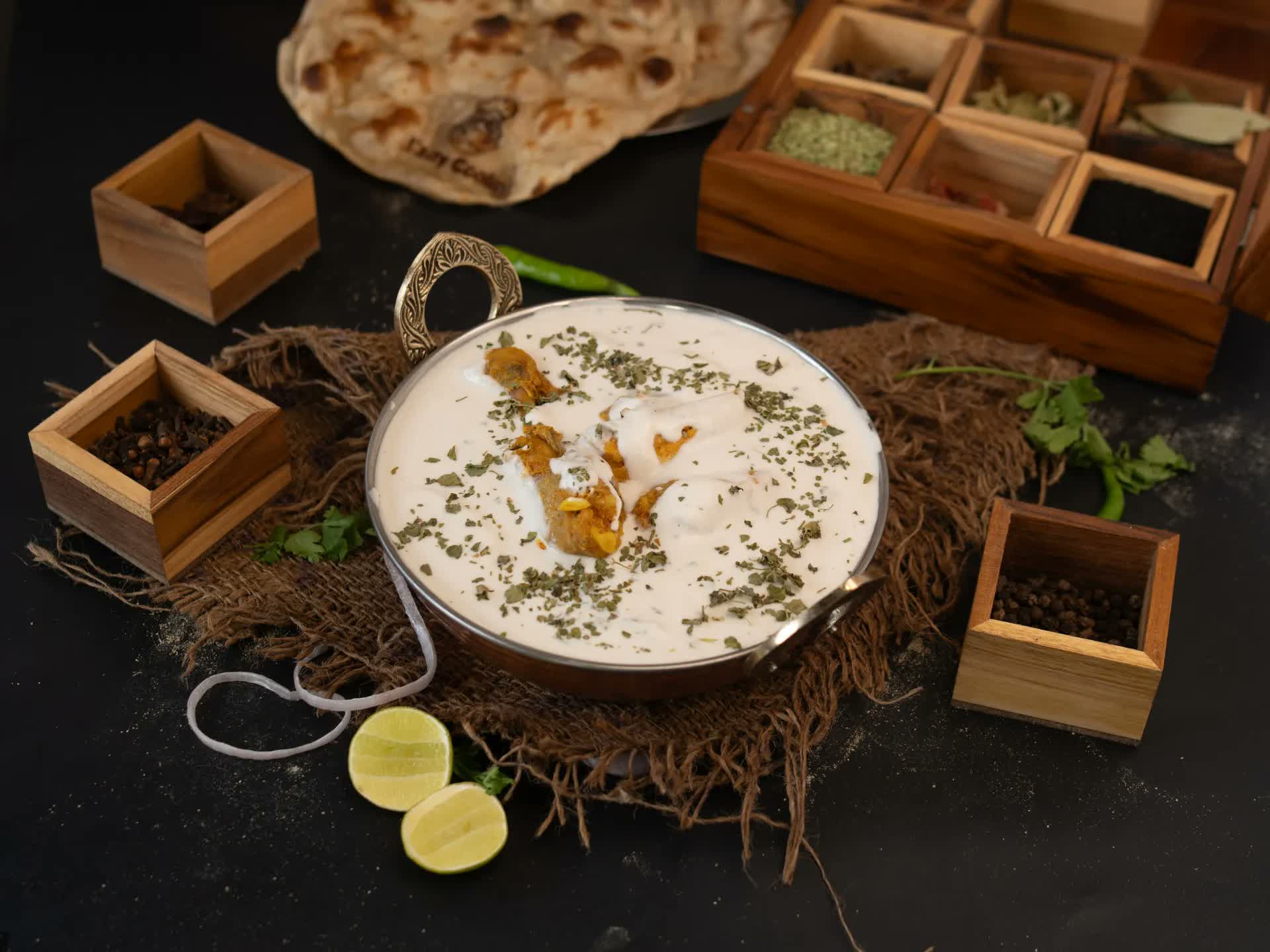
Short answer: one restaurant plate of white karahi (about 300 g) has roughly 700 to 850 calories. The same weight made at home, with a lighter hand on the cream, lands closer to 550 to 650. Per 100 g, expect roughly 180 to 290 kcal depending on how much cream, butter and oil the cook used. White karahi is almost always heavier than the red version, and the reason is sitting right there in the colour.
White karahi skips tomatoes entirely. That is the whole point of the dish. Instead of a tomato masala, the chicken simmers in whisked yogurt, then gets finished with cream, ginger, green chilies and black or white pepper. Some kitchens add butter at the end, some add a handful of grated cheese, and restaurant versions often do both. No tomato bulk means the sauce is mostly dairy fat, so every spoonful of gravy carries more calories than the same spoonful of red karahi gravy.
What actually sets the number
The cream. This is the biggest lever. A home recipe for half a kilo of chicken might use a quarter cup of cream. A restaurant karahi can easily use double that, plus a butter finish. USDA FoodData Central lists heavy whipping cream at about 340 kcal per 100 g, so a couple of extra spoonfuls across the pot adds up fast even before the plate is served.
The butter and cheese finish. A tablespoon of butter is about 100 kcal, and it goes into the pot without changing the look of the dish at all. Cheese does the same job more quietly. If your karahi arrives glossy and rich enough to coat the spoon, price it at the top of the range.
The oil at the start. White karahi still starts with oil or ghee in the karahi. Two tablespoons for the pot versus four is a swing of roughly 240 kcal across the whole dish, and restaurants tend toward the generous end.
The chicken cut. Boneless breast is the leanest option. USDA FoodData Central puts cooked skinless chicken breast at about 165 kcal and 31 g of protein per 100 g. Traditional bone in mixed pieces, skin still on, run higher in fat and lower in protein per 100 g, though most people find them tastier in a karahi.
The yogurt to cream ratio. Yogurt is doing real work here, and it is the lighter half of the sauce. A yogurt heavy karahi, where cream is a finishing touch rather than the base, can sit 30 to 50 kcal lower per 100 g than a cream heavy one. Some recipes also blend in cashew paste, which thickens beautifully and adds fat with it.
How much gravy you scoop. In a family style karahi, this matters more than people admit. The meat is the protein. The gravy is where the cream, butter and oil live. Two people can eat from the same karahi and land hundreds of calories apart, simply because one of them ladled mostly chicken and the other ladled mostly gravy.
White karahi calories and macros
| Food | Portion | Calories | Protein | Carbs | Fat |
|---|---|---|---|---|---|
| White karahi, homemade | 100 g | 180 to 220 | 15 to 18 g | 3 to 5 g | 11 to 15 g |
| White karahi, restaurant | 100 g | 240 to 290 | 14 to 17 g | 3 to 6 g | 18 to 24 g |
| White karahi, homemade | 1 cup, about 250 g | 450 to 550 | 38 to 45 g | 8 to 13 g | 28 to 38 g |
| White karahi, restaurant | 1 plate, about 300 g | 700 to 850 | 42 to 51 g | 9 to 18 g | 54 to 72 g |
| White karahi, homemade | 1 plate, about 300 g | 550 to 650 | 45 to 54 g | 9 to 15 g | 33 to 45 g |
Restaurant rows assume extra cream and a butter finish. Homemade rows assume yogurt doing most of the work and cream used sparingly. Bone in pieces sit a little lower in protein per 100 g than boneless breast, since bone and skin add weight without adding protein.
White karahi vs red karahi
Side by side, the gap is plain. Our chicken karahi breakdown puts the classic tomato version at roughly 150 to 200 kcal per 100 g. White karahi starts where red karahi ends and climbs from there. That does not make white karahi a bad dish. It is still a genuinely high protein meal, and a plate can cover a large share of a day's protein target (see how much protein you need per day). It just means the creamy version is the one to portion with care, not the one to eat freely because it looks lighter. Pale is not light.
The comparison holds against other creamy dishes too. Butter chicken and malai boti live in the same rich territory, built on the same cream and butter logic. If you like this style of food, the calorie story is consistent across all of them: wonderful protein, expensive sauce.
Making a lighter white karahi without ruining it
White karahi survives lightening better than most creamy dishes, because yogurt already carries much of the flavour. Keep the ginger, green chilies and pepper exactly as they are, since those cost almost nothing calorically and define the dish. Then change the fat, not the flavour:
Use yogurt as the base and treat cream as a garnish, a few spoonfuls stirred in at the end rather than half a cup cooked through. Skip the butter finish entirely on a weeknight version. Choose boneless breast or skinless pieces if the karahi is an everyday meal rather than a weekend one. And serve it with roti instead of naan where you can, since a naan adds 280 to 400 kcal (naan calories) while a roti adds roughly 100 to 150 (roti calories). None of this turns white karahi into diet food. It just moves a restaurant plate of 800 kcal toward a homemade plate of 550, which is a difference you can actually feel across a week.
How to track white karahi in seconds
Describe it the way it looks on the plate:
"1 plate restaurant white karahi + 1 naan"
In CalsFlow, that gives you the calorie and macro estimate plus the assumptions behind it: the portion it priced in, and how much cream and oil it allowed for. Ate a homemade version with light cream, or mostly chicken with little gravy? Say so and the estimate moves with it. The same describe what you see approach sits at the heart of our guide to counting calories in Pakistani and desi food. After a few karahi nights logged this way, you will know if your usual plate sits near the homemade end or the restaurant end, which is the only number that actually matters for your tracking.
FAQs
How many calories are in 1 cup of white karahi? About 450 to 550 kcal for a homemade cup of roughly 250 g. A restaurant cup, richer in cream and butter, runs closer to 600 to 725.
Is white karahi healthier than red karahi? Usually not, calorie for calorie. Red karahi has tomato bulk and less dairy fat, so it lands lower per 100 g. White karahi wins on nothing except richness, which to be fair is the reason people order it.
Does white karahi have tomatoes? No. That is what makes it white. The sauce is yogurt and cream, seasoned with ginger, green chilies and pepper. If tomatoes show up, you are eating a different karahi.
Is white karahi good for weight loss? It can fit, in a smaller portion, with a yogurt heavy homemade version and roti instead of naan. As a full restaurant plate with naan, it is a big meal, and tracking it honestly matters more than avoiding it.
How much protein is in white karahi? Roughly 14 to 18 g per 100 g as served. A restaurant plate gives you about 42 to 51 g, which is a solid share of most people's daily target.
The bottom line
White karahi: 180 to 220 kcal per 100 g homemade, 240 to 290 restaurant, and 700 to 850 for a restaurant plate. The chicken is not the issue. The cream, butter and oil are, and they are also the reason the dish tastes the way it does. Eating white karahi tonight? Describe it in CalsFlow, set the cream assumption to match your plate, and get your real number in seconds.
CalsFlow provides nutrition estimates, not medical advice.