

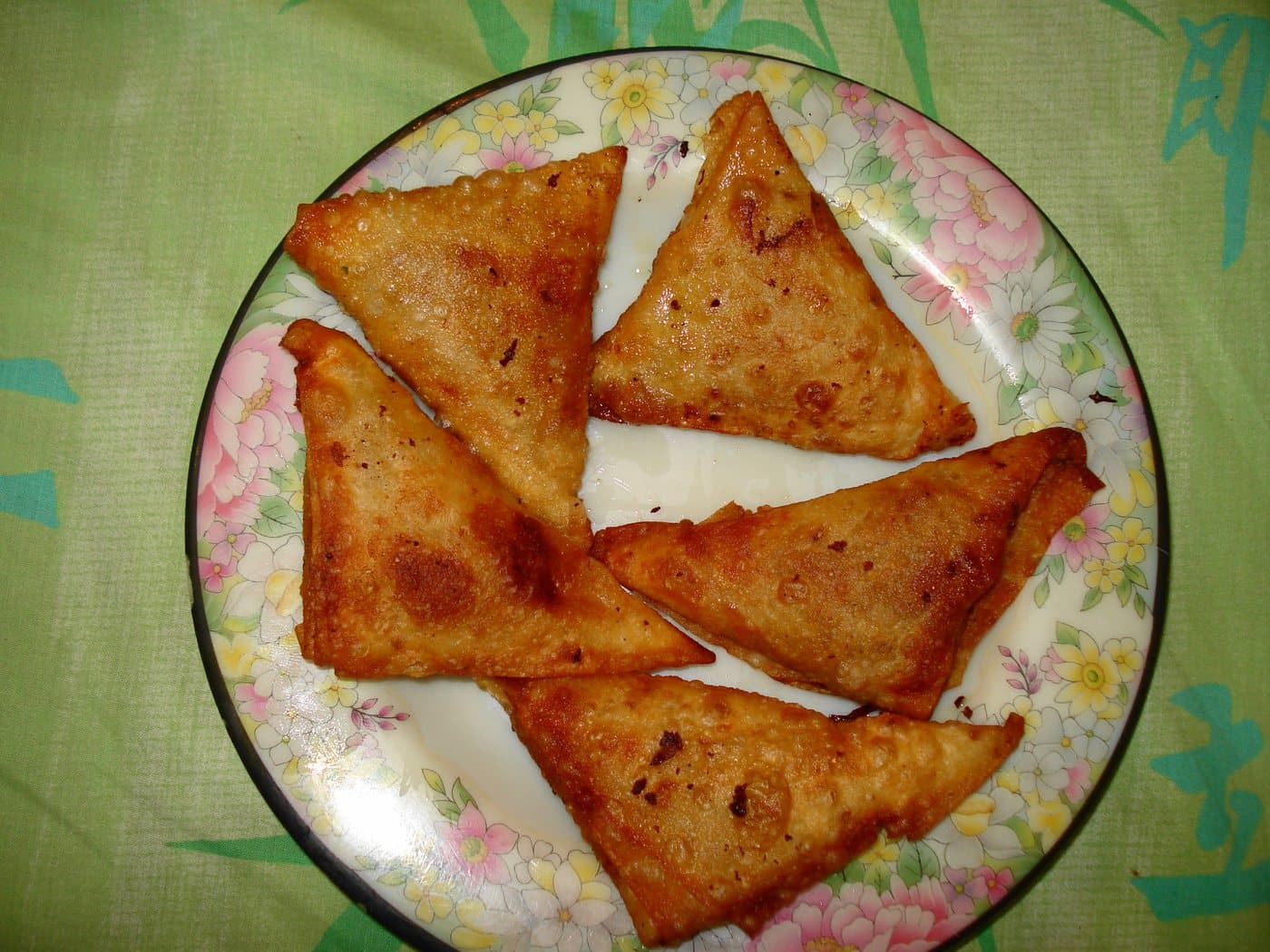
Short answer: one deep-fried aloo samosa carries 130 to 220 calories, and size decides the number far more than the filling does. A small 30 gram street samosa sits near 130 kcal, a chunky 50 gram bakery piece lands around 217. A dietitian-authored breakdown puts the small, medium, and large pieces at 130, 173, and 217 kcal respectively (clearcals.com).
The honest complication: this is a fried snack, and frying is not a fixed cost. Another recipe analysis of a 100 gram samosa lands at 262 kcal (nutriscan.app), while a detailed recipe breakdown from the same dietitian source comes in at 419 kcal per 100 grams (clearcals.com). Both can be right. The difference is almost entirely how much oil the pastry drank.
What actually sets the number
The shell. Maida pastry, rolled thin, folded, and deep fried. This is the largest calorie contributor, not the filling. In that 419 kcal per 100 gram recipe analysis, 28 of the 100 grams are fat. Oil absorption varies with frying temperature, how long the piece sits in the oil, and how many batches the oil has already seen. Street and bakery samosas, fried in bulk all day, absorb more than a careful homemade batch.
The filling. Boiled potato with peas and masala is the classic, mostly carbs, and modest next to the shell. A qeema samosa trades some potato for minced meat, which raises protein a little and adds some fat. Chicken and plain vegetable versions sit in the same range as aloo.
The chutney. Rarely counted, always added. A tablespoon of imli chutney runs about 30 to 40 kcal of mostly sugar, while green mint chutney is close to zero. Two samosas with two generous spoons of imli can pick up an extra 60 to 80 kcal that never shows up in the per-piece numbers.
Samosa calories and macros
| Samosa | Portion | Calories | Protein | Carbs | Fat |
|---|---|---|---|---|---|
| Mini cocktail samosa, fried | ~20 g | 80 to 100 | ~1 g | 8 to 10 g | 5 to 7 g |
| Small street aloo samosa | ~30 g | 120 to 140 | 1 to 2 g | 10 to 12 g | 8 to 10 g |
| Standard bakery aloo samosa | ~40 g | 160 to 190 | 2 to 3 g | 14 to 16 g | 11 to 13 g |
| Large restaurant aloo samosa | ~50 g | 200 to 230 | 2.5 to 3.5 g | 18 to 20 g | 13 to 15 g |
| Qeema samosa | ~40 g | 170 to 210 | 4 to 6 g | 12 to 14 g | 11 to 14 g |
| Baked aloo samosa | ~40 g | 130 to 150 | 2 to 3 g | 20 to 24 g | 3 to 5 g |
Per-piece rows follow the dietitian size breakdown (130, 173, 217 kcal for 30, 40, and 50 grams) with ranges widened to cover recipe differences. The baked row applies the widely reported 40 to 50 percent reduction from baking rather than frying (nutriscan.app), scaled from the fried recipe; your recipe may differ.
Why two sources can both be right
A gap like 262 versus 419 kcal per 100 grams looks like someone is wrong. Nobody is. Hot, fresh oil seals the pastry quickly and the piece stays crisp. Oil that has cooled down, or that has fried a hundred batches, seeps in instead. Thicker pastry drinks more. A home samosa where you control the oil, the temperature, and the thickness lands low. A Ramadan iftar batch, fried back to back in the same karahi all evening, lands high.
This is why "one samosa equals X calories" claims deserve skepticism. The recipe is the number. Where a number matters, the two facts that move it most are the size and whether it came from a home karahi or a bulk fryer.
The chaat problem
A samosa eaten alone is a snack. A samosa chaat is a different food. Crush the samosa, add a cup of chana, spoon over imli chutney, yogurt, and onions, and the samosa becomes a garnish on a small meal. Count the chaat as a meal and log the samosa inside it as one piece, or the estimate lands way off. Our chana calories guide has the numbers for the biggest component of the plate.
How to track a samosa in seconds
Type it the way you would describe it to a friend:
"2 small street aloo samosas with imli chutney"
In CalsFlow you get the calorie and macro estimate plus the assumptions behind it: the size it assumed, the oil level it priced in, and whether the chutney was counted separately. Had qeema instead of aloo, or mint chutney instead of imli? Say so and the estimate shifts with the details. Same describe-what-you-see approach as our guide to counting calories in Pakistani and desi food.
Samosa and weight loss
One small samosa fits into almost any eating plan; it is roughly a third of the calories of a bakery paratha (see our paratha calories guide). The problem is never one samosa. They arrive in pairs at chai time, the chutney is free, and the second one tastes better than the first. If samosas are a daily habit, the baked version cuts a meaningful chunk of calories without changing the ritual. For the chai that usually comes with it, see our Pakistani chai calories breakdown.
FAQs
How many calories are in 1 samosa? A standard street or bakery aloo samosa (30 to 50 grams) carries 130 to 220 kcal, depending on size and how much oil the pastry absorbed. Mini cocktail samosas run 80 to 100 kcal each.
How many calories are in 2 samosas? Two small street samosas land around 240 to 280 kcal before chutney. Two large bakery pieces reach 400 to 460. Add imli chutney and tack on another 30 to 80 kcal.
Are baked samosas healthier? Meaningfully lighter: about 40 to 50 percent fewer calories, mostly from much less fat, with the same potato filling. The texture is different, less shattering and crisp, but for a regular snack the swap is worth it.
How many calories in a samosa with imli chutney? The samosa itself plus roughly 30 to 40 kcal per tablespoon of imli chutney. Green mint chutney adds almost nothing. The sweet chutney is the one that changes the total.
Is samosa good for weight loss? Occasionally, sure. It is an honest, countable snack. The risk is the pattern: daily pairs with sweet chutney add up fast. Log the count, name the chutney, and it stays inside a plan.
The bottom line
One aloo samosa: 130 to 220 kcal, sized by the piece and the oil. Qeema runs a little higher on protein, baked runs a lot lower on fat, and the imli chutney is never free. Having samosas today? Describe the plate in CalsFlow: count, size, filling, and which chutney, and get your real number.
Cover photo: fried samosas, public domain via Wikimedia Commons. CalsFlow provides nutrition estimates, not medical advice.