

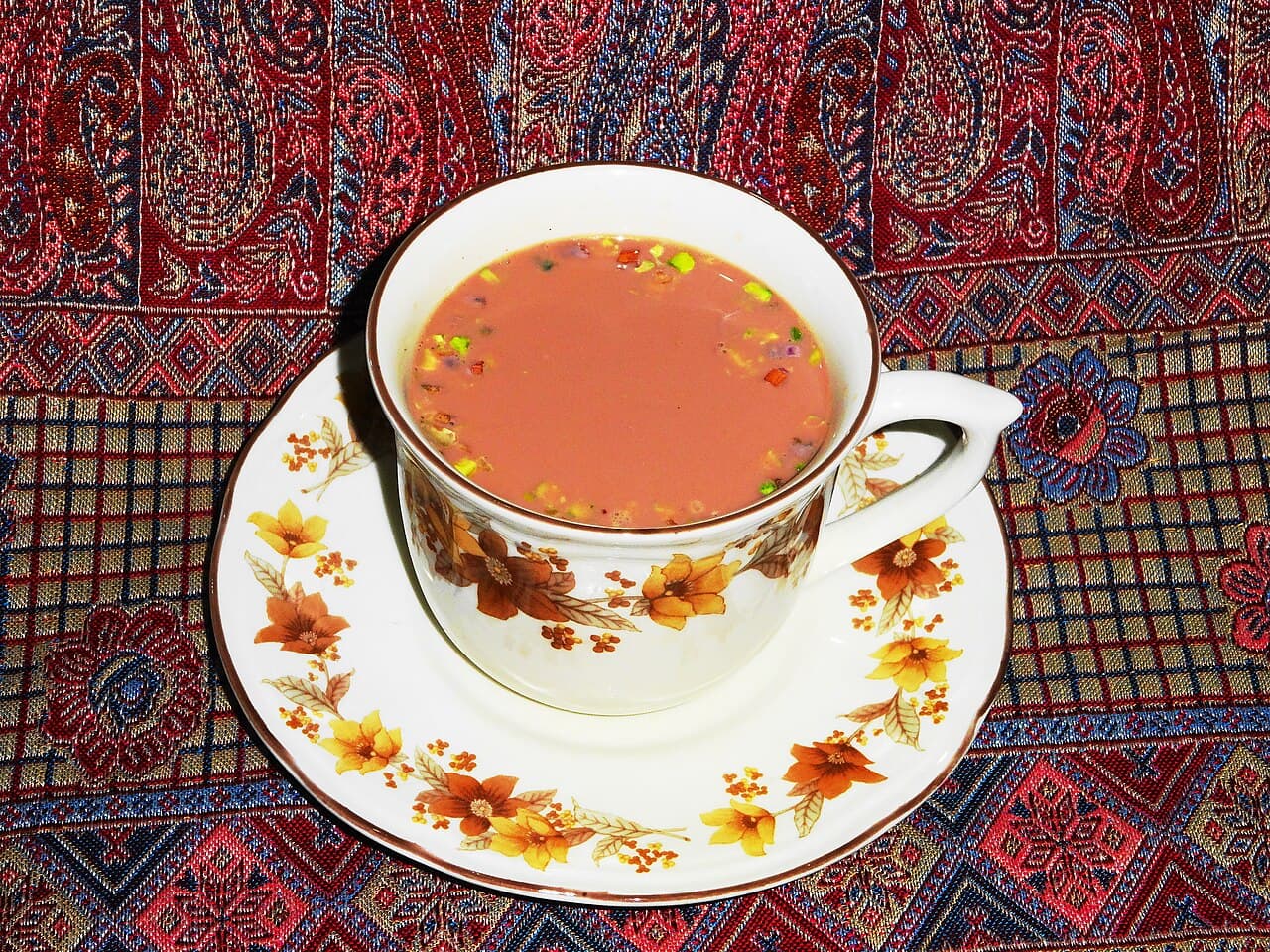
Short answer: a traditional salted cup of Kashmiri chai, about 200 ml, runs roughly 90 to 120 calories. A homemade sweet cup with two teaspoons of sugar lands closer to 120 to 160, and a rich cafe or wedding cup, sweetened and topped with cream and a generous handful of crushed nuts, can reach 220 to 300. The tea itself is almost calorie free. Milk, sugar, nuts and cream decide the number, in that order.
Kashmiri chai is not doodh patti dyed pink. It starts with green tea leaves boiled long with a pinch of baking soda, which turns the brew deep red, then milk is added and the colour softens to pink. Cardamom usually goes in. In Kashmir the classic version, noon chai, is salted rather than sweet. In much of Pakistan, especially at weddings and cafes in winter, the same pink tea turns up sweet, sometimes with both a pinch of salt and sugar, and almost always with crushed almonds and pistachios on top.
Calories and macros
| Food | Portion | Calories | Protein | Carbs | Fat |
|---|---|---|---|---|---|
| Traditional salted noon chai, pinch of nuts | 1 cup (about 200 ml) | 90 to 120 kcal | 5 to 7 g | 9 to 13 g | 4 to 6 g |
| Homemade sweet chai, 2 tsp sugar, pinch of nuts | 1 cup (about 200 ml) | 120 to 160 kcal | 5 to 7 g | 19 to 25 g | 4 to 6 g |
| Sweet chai, generous crushed nuts | 1 cup (about 200 ml) | 160 to 210 kcal | 6 to 8 g | 20 to 27 g | 8 to 12 g |
| Sweet chai with malai or cream | 1 cup (about 200 ml) | 190 to 250 kcal | 6 to 8 g | 20 to 27 g | 11 to 15 g |
| Cafe or wedding cup, sweet, cream, generous nuts | 1 large cup (about 250 ml) | 220 to 300 kcal | 7 to 10 g | 26 to 34 g | 13 to 18 g |
| Small takeaway cup, sweet | 1 small cup (about 150 ml) | 90 to 140 kcal | 4 to 6 g | 14 to 20 g | 4 to 6 g |
The maths behind the table is simple enough to check at home. Whole cow milk carries about 150 kcal per cup, or roughly 60 kcal per 100 ml, according to USDA FoodData Central. A 200 ml cup of Kashmiri chai is not all milk, since part of it is brewed tea water, so a typical cup holds around 120 to 150 ml of milk. That alone is 75 to 95 kcal. One teaspoon of sugar adds about 16 kcal. A light sprinkle of nuts adds 10 to 20 kcal, while a full tablespoon of crushed almonds and pistachios adds closer to 50. A spoon of malai or cream adds another 40 to 60. Add those pieces in the combination your cup actually has and you land inside the ranges above.
Salted or sweet changes everything except the colour
Salt adds no calories. That is the whole trick of the traditional version. A salted noon chai can taste rich because of the milk and nuts while staying near the bottom of the range. Sugar is what pushes the same cup up by 30 to 50 kcal, and it does so quietly, because milk and cardamom soften the sweetness.
Buffalo milk pushes the number up further. Households buying from a doodh wala often get buffalo milk, which runs around 90 to 100 kcal per 100 ml against roughly 60 for cow milk. A salted cup made with buffalo milk can match a sweet cow milk cup, even before sugar enters the picture. If your house uses buffalo milk, log toward the top of every range.
Cup size is the other quiet variable. Wedding and cafe servings run large, often 250 ml or more, and they are also the servings most likely to carry cream and extra nuts. A small takeaway cup looks like a bargain at 90 to 140 kcal, but that is mostly because it is smaller, not because the recipe is lighter.
How Kashmiri chai compares with other Pakistani teas
Doodh patti, covered in our Pakistani chai calories guide, is black tea made with all milk, and a sweet homemade cup runs 130 to 170 kcal. Kashmiri chai sits in a similar place once sweetened, because the milk and sugar are doing the same work. The salted version is the lighter outlier, and it has no real equivalent in the doodh patti world.
Kahwa is the other Kashmiri tea people confuse this with, and it is a different drink. Kahwa is green tea brewed with cardamom, cinnamon and saffron, usually served without milk, so it carries almost no calories before sugar or nuts. Kashmiri chai is the milky, pink, winter version. Same region, opposite approach to milk.
Drinking it without blowing the day
Two or three sweet cafe cups a day add 450 to 900 kcal, and that total slips past people precisely because tea feels like a break, not a meal. The salted version avoids most of that problem. Three salted cups land around 270 to 360 kcal, which is easier to fit into a normal day.
Small swaps keep the ritual intact. Keep the salt, drop the sugar, and you save about 30 kcal a cup. Keep a pinch of nuts for flavour and crunch instead of a heaped tablespoon and you save another 30 or so. Skip the malai on top and the cup drops by 40 to 60. None of these changes the pink colour or the cardamom smell that makes the tea what it is. What fails is the combination of a large sweet cup, cream, generous nuts and a plate of Kashmiri bread or biscuits on the side, repeated three times a day through winter.
How to track Kashmiri chai in CalsFlow
In CalsFlow, type:
"1 cup Kashmiri chai, sweet, nuts, no cream, 200ml"
You get the calorie and macro estimate plus the assumptions behind it: how much milk it guessed, how much sugar, whether nuts were counted. Drink the salted version at home? Type "salted, no sugar" and watch the number drop. Drink mostly cafe cups? Add "cream, extra nuts, large cup" and the estimate moves to where your cup actually lives. The useful habit is naming the sugar, the nuts and the cream, because those three lines decide nearly the whole estimate. Same honest entry approach as our guide to counting calories in Pakistani and desi food.
FAQs
How many calories are in Kashmiri chai without sugar?
A salted 200 ml cup with a pinch of nuts runs about 90 to 120 kcal, all from the milk and nuts. Without nuts it drops a little further, to roughly 80 to 110.
Is Kashmiri chai good for weight loss?
The salted version can fit a weight loss plan easily. The sweet cafe version is harder to fit, not because tea is bad, but because sugar, cream and nuts stack up fast. Pick the salted cup, or sweeten lightly and skip the cream.
Why is Kashmiri chai pink?
Green tea leaves boiled with a pinch of baking soda turn deep red, and adding milk softens that red to pink. No food colouring is needed for the classic colour, though some instant mixes use it.
Does the salt in noon chai add calories?
No. Salt has no calories. It does add sodium, so if you drink many salted cups a day, the sodium adds up even though the calories stay low.
Is a cafe Kashmiri chai the same as homemade?
Rarely. Cafe and wedding cups tend to be larger, sweeter, and topped with more cream and nuts. Log a cafe cup toward the top of the range, and a plain homemade salted cup toward the bottom.
Kashmiri chai earns its winter reputation honestly. It is warm, fragrant and genuinely comforting on a cold evening, and the salted version is lighter than most people expect. The expensive cup is the sweet, creamy, nut loaded one, and now you know exactly which parts of it cost the calories. Drinking one tonight? Describe it in CalsFlow, check whether it counted a salted cup or a cafe cup, and get your real number in seconds.
Sources: calorie and macro ranges are estimated from USDA FoodData Central values for whole milk (about 150 kcal per cup), granulated sugar (about 16 kcal per teaspoon) and tree nuts, adjusted for typical Kashmiri chai milk share, serving sizes and toppings. One published listing for Kashmiri noon chai puts a 240 g cup at about 112 kcal, which sits inside the salted range above.
Cover photo: Kashmiri chai by Miansari66 via Wikimedia Commons (CC0).
CalsFlow provides nutrition estimates, not medical advice.