

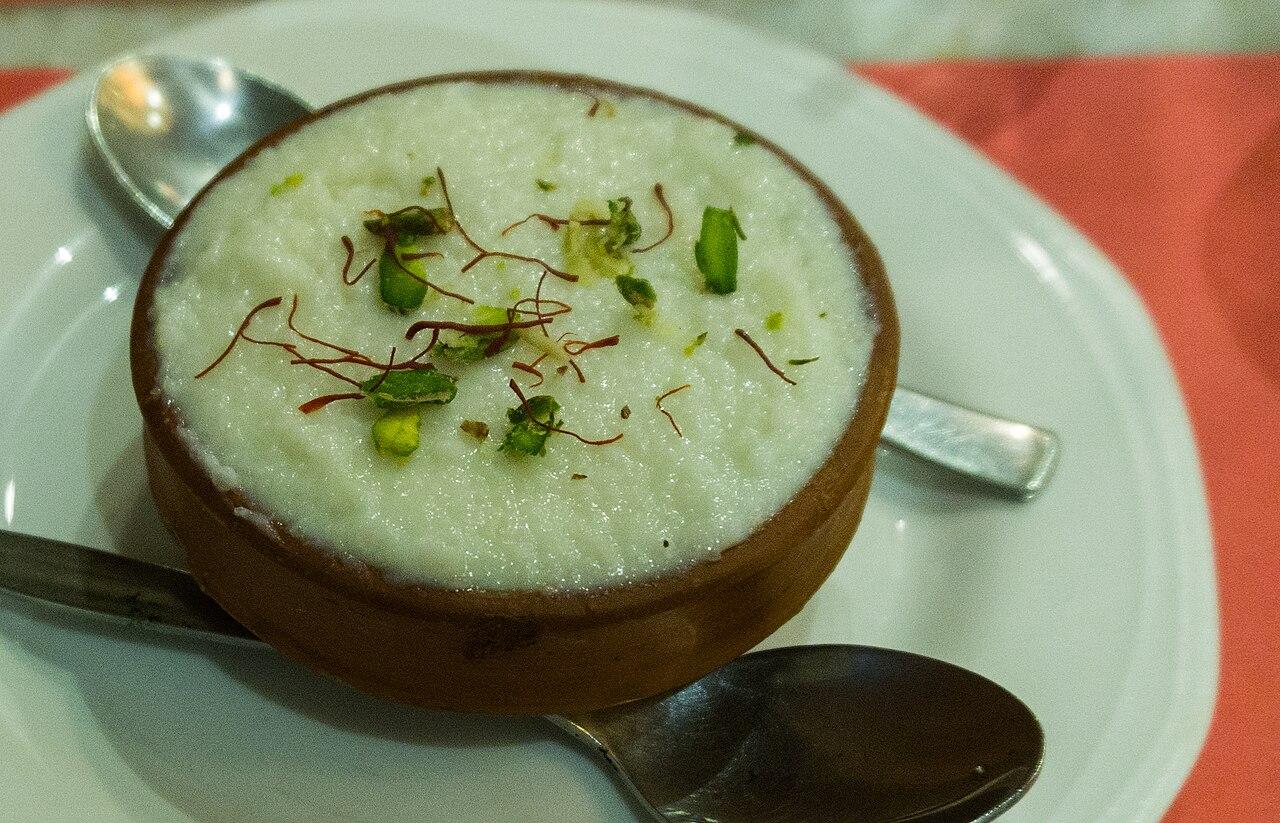
Short answer: a small bowl of firni, about 150 grams, usually lands between 170 and 270 calories. Per 100 grams it sits somewhere around 110 to 180. The clay matka bowls served at restaurants and dawats hold more, often 250 to 300 grams, and those run 280 to 450 calories. Milk and sugar do almost all of the work in that number, so a lighter home version and a rich restaurant version can be two very different desserts with the same name.
Firni is ground rice simmered in milk until it thickens, sweetened, scented with cardamom and usually finished with pistachios, almonds and a few strands of saffron. It sets as it cools, firm enough to hold its shape in the bowl, and it is served chilled, most often in individual earthen bowls. That is the detail that separates it from kheer. Kheer uses whole rice grains and stays pourable, like a thick soup. Firni uses rice ground to a coarse flour, so it sets like a soft pudding. Same family, different texture, and the calorie counts land in a similar range.
Why one bowl can differ so much from another
The milk. A home firni made with toned or low fat milk sits at the bottom of every range. Whole milk moves it up, and buffalo milk, which many Pakistani households buy from the doodh wala, moves it further still. Whole cow milk carries about 60 calories per 100 ml (USDA FoodData Central), while buffalo milk runs closer to 100. Restaurants sometimes finish with condensed milk or khoya for body, and that pushes the count to the top of the range.
The sugar. Sugar is the second lever and it is easy to underestimate. A standard home recipe uses roughly 6 tablespoons of sugar for 5 cups of milk, which works out to about 15 grams of sugar in each serving. Sweeter restaurant and Eid versions can carry half as much again, and every spoonful shows up directly in the calorie count.
The garnish. A spoonful of chopped pistachios and almonds adds flavour and a little fat, roughly 20 to 30 calories. It is the smallest of the three levers and the one worth keeping. The nuts are also where most of the little protein and fibre in the bowl comes from.
The bowl itself. There is no standard firni bowl. A small home bowl holds about 150 grams. A restaurant matka can hold 250 to 300. Same recipe, double the portion, double the calories. If you are logging firni, the bowl size matters more than the recipe.
Firni calories and macros
| Portion | Calories | Protein | Carbs | Fat |
|---|---|---|---|---|
| 100 g firni | 110 to 180 | 3 to 5 g | 16 to 24 g | 4 to 8 g |
| 1 small bowl, about 150 g | 170 to 270 | 5 to 7 g | 24 to 36 g | 6 to 12 g |
| 1 restaurant matka bowl, about 250 g | 280 to 450 | 8 to 12 g | 40 to 60 g | 10 to 20 g |
| 1 spoonful, about 30 g | 35 to 55 | 1 g | 5 to 7 g | 1 to 2 g |
Two recipe analyses anchor these ranges. The Indian Food Composition Tables based analysis puts phirni at 116 calories per 100 grams, with a 290 gram bowl at 337 calories (idyora.com), while Tarla Dalal's tested recipe lands at 344 calories a serving with 9.3 grams of protein (tarladalal.com). Richer versions made with condensed milk or extra khoya sit above those numbers, which is why the top of each range runs higher.
Firni or kheer, which is lighter
Neither wins by much. Kheer lands in the same 110 to 180 calories per 100 grams, and a regular bowl of it runs 170 to 270. Sheer khurma is usually the heavier of the three, since it is built on vermicelli fried in ghee. The difference between firni and kheer is portion and recipe, not the dish. A small bowl of firni and a small bowl of kheer are near identical on calories. What usually decides it is what sits next to them on the table. Firni often arrives after a full dawat dinner, so the bowl is the second dessert, not the first. If you are choosing between them, pick the one you actually want and take the smaller bowl.
How it adds up at a dawat
Firni is rarely eaten alone. It comes at the end of a meal that already included biryani, kebabs and naan, and it arrives in a matka that looks small until you do the math. A 250 gram bowl at the top of the range is 450 calories, roughly a fifth of a 2,000 calorie day, after dinner. The sugar matters too. A small bowl carries roughly 10 to 20 grams of sugar, which is around a third of the daily free sugar limit the WHO suggests keeping under 10 percent of total energy. None of that makes firni a problem on its own. It makes the second bowl the decision that counts.
Logging firni in CalsFlow
Type "1 matka firni" and CalsFlow will estimate from a standard recipe, usually landing near 300 to 400 calories. That assumes a restaurant style bowl with whole milk and a normal amount of sugar. If yours was a small home bowl made with toned milk, tap the portion down to about 150 grams and the estimate drops toward 200. If it was an extra sweet Eid version with condensed milk, nudge it up. The number is only as good as the portion you enter, and with firni the portion is the whole game. If you want a refresher on portion guessing for desi food in general, the guide to counting calories in desi food covers the same problem across a full plate.
A lighter bowl without losing the point
Cut the sugar by a third and most people will not notice once the cardamom and saffron are in. Toned milk instead of whole milk pulls the bowl toward the bottom of the range, and skipping condensed milk does more than either change on its own. Serve it in the small bowls, not the big matkas, and the portion takes care of itself. Keep the nuts on top. They add crunch and a little protein for very few calories, and a firni without them tastes unfinished.
Quick answers
Is firni good for weight loss? Not especially. It is milk, rice and sugar, so it fills you for a short while and then the sugar leaves you hungry again. A small bowl fits fine inside a calorie deficit. A large matka after a heavy dinner usually does not. If you are tracking a daily target, check how many calories you should eat per day and see where the bowl lands.
How many calories are in one bowl of firni? A small home bowl of about 150 grams runs 170 to 270 calories. A restaurant matka bowl of about 250 grams runs 280 to 450.
If you had firni at a dawat last night, log it while you still remember the bowl size. Describe the meal in CalsFlow, adjust the portion to match the bowl you actually ate, and you will know where it landed instead of guessing.
Cover photo: Sumit Surai via Wikimedia Commons (CC BY-SA 4.0).
CalsFlow provides nutrition estimates, not medical advice.