

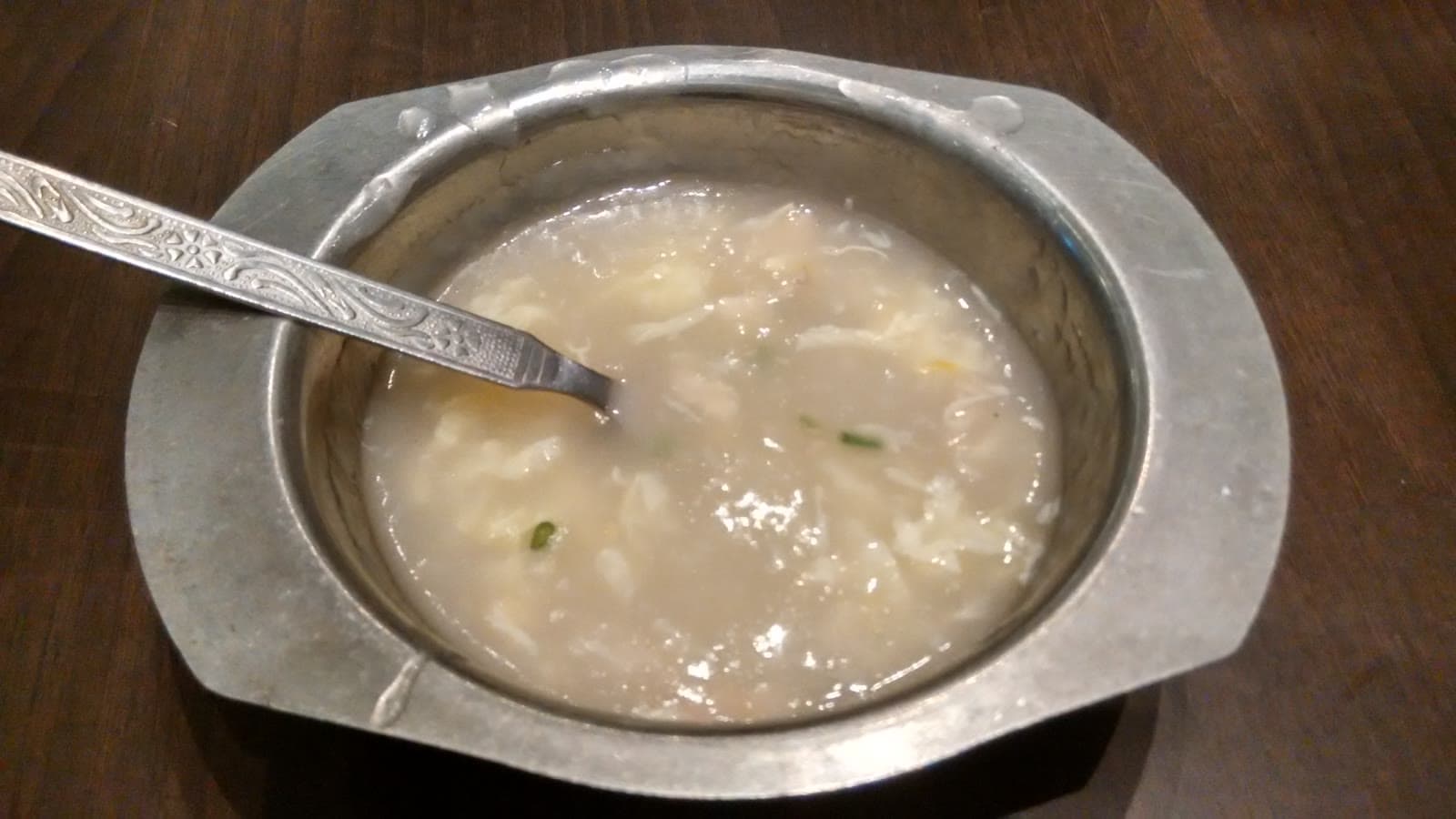
Short answer: a cup of homemade chicken corn soup (about 240 ml) has 120 to 170 calories. A bowl from a street cart or restaurant, usually 350 to 400 ml and noticeably thicker, runs 220 to 320 calories. Per 100 g, expect 50 to 90 kcal. The gap between the light end and the rich end comes down to three things: cornstarch, egg, and oil.
Chicken corn soup is a winter fixture in Pakistan. When the temperature drops, carts outside restaurants and small soup stalls start ladling it out all evening, usually with soy sauce, vinegar, and chilli sauce on the side for each person to season their own bowl. The soup itself is simple: chicken stock, shredded chicken, sweet corn, and egg ribbons, thickened with cornstarch. That simplicity is why it can be so light, and also why a heavy handed cook can quietly double it.
What decides the number
How thick it is. Cornstarch is the main lever. A light homemade soup uses just enough to give the broth a little body. A cart soup is often thick enough to coat the spoon, and that extra starch is pure carbohydrate. Thickness alone can add 50 to 80 calories to a bowl.
The egg. Pakistani style chicken corn soup usually has egg whisked in as ribbons. One egg spread across a pot adds a little protein and a little fat, roughly 70 calories for the whole pot, so a single bowl gains maybe 20 to 30 calories from it. It is not the thing that makes the soup heavy, but it is part of why the homemade and cart versions differ from a plain canned soup.
How much chicken is actually in it. Some bowls are mostly broth and corn with a few shreds of chicken. Others are generous with it. More chicken means more protein and a few more calories, and it is the difference that actually keeps you full. A bowl with real chicken in it is a better meal than a bowl that is mostly starch.
Oil and butter. A traditional home recipe starts with stock and adds nothing fatty. Some restaurants finish the soup with a little butter or use a rich, oily stock. You can usually tell by looking: if the surface shines and a layer of oil gathers at the edge, log the top of the range.
Noodles and sauces. Noodles are the biggest single add on. A serving of boiled noodles stirred into the bowl adds roughly 130 to 180 calories. The sauces on the side are small by comparison, a spoon of soy sauce or vinegar adds almost nothing, but a sweet chilli sauce can add 20 to 40 calories if you pour freely.
Chicken corn soup calories and macros
| Food | Portion | Calories | Protein | Carbs | Fat |
|---|---|---|---|---|---|
| Homemade, light | 1 cup (240 ml) | 120 to 170 | 6 to 9 g | 16 to 22 g | 2 to 5 g |
| Homemade, light | 100 g | 50 to 70 | 3 to 4 g | 7 to 9 g | 1 to 2 g |
| Street cart or restaurant bowl | 1 bowl (350 to 400 ml) | 220 to 320 | 12 to 18 g | 28 to 40 g | 6 to 12 g |
| Street cart or restaurant bowl | 100 g | 60 to 90 | 3 to 5 g | 8 to 11 g | 2 to 4 g |
| With noodles added | 1 bowl (350 to 400 ml) | 350 to 480 | 15 to 21 g | 48 to 62 g | 8 to 14 g |
| Canned or packet, plain | 1 cup (240 ml) | 90 to 130 | 3 to 6 g | 12 to 18 g | 1 to 4 g |
Published nutrition databases put a plain cup anywhere from about 90 to 130 calories, and the USDA FoodData Central entry for a canned chicken corn chowder lists 79 calories per cup with 3 g of protein. Those plain versions are thinner and lighter than what a Pakistani cart serves, which is why the street cart bowl on this page sits higher. The numbers here are ranges because no two carts make it the same way.
Logging it in CalsFlow
Soup is one of the harder things to log from memory because the bowl size and the thickness both matter. Say you had a cart bowl with egg and no noodles. In CalsFlow you could enter "1 bowl chicken corn soup, street cart style, with egg". CalsFlow would assume a 375 ml bowl, egg ribbons, and medium thickness, and return something around 240 to 300 calories. If your bowl was actually a small cup, you adjust the portion down and the estimate drops to roughly 150 to 190. If it was a thick bowl with noodles, you add the noodles as a separate line and the total lands near 400. The habit that matters is naming the version you actually ate, not just "soup".
That same approach works for the rest of a Pakistani meal. The Pakistani food calorie chart covers the usual plates and sides, and counting calories in Pakistani and desi food explains how to estimate portions for dishes that never come with a label.
Is chicken corn soup good for weight loss?
As soups go, yes, with one condition. It is high volume and low calorie density, so a bowl fills you up for relatively few calories, and the chicken and egg give it enough protein to count as a light meal rather than a snack. The catch is the sodium. Canned and packet versions commonly carry 600 to 900 mg of sodium per cup, and cart soups seasoned with soy sauce can run higher still. The WHO daily guidance for adults is under 2,000 mg of sodium, so one very salty bowl can eat up half the day. A homemade version with controlled salt avoids that problem entirely.
If weight loss is the goal, the lighter homemade cup is the better regular choice, and the cart bowl works fine as an occasional dinner as long as the noodles stay out of it. For the bigger picture on how much you actually need in a day, see how many calories you should eat per day, and for what the protein, carb, and fat numbers mean, see what macros are.
FAQs
Is chicken corn soup healthy? The homemade version is. It is light, it has real chicken and egg for protein, and corn adds some fibre. The cart version is still reasonable, but the extra starch and salt make it a sometimes food rather than an everyday one.
How many calories are in chicken corn soup with noodles? A 350 to 400 ml bowl with noodles runs 350 to 480 calories, roughly 130 to 180 more than the same bowl without them. If you want the soup to stay light, skip the noodles or ask for half a portion.
Does chicken corn soup have a lot of protein? Not a lot. A light cup has 6 to 9 g, and a generous cart bowl has 12 to 18 g. That is a decent amount for a soup but well short of a chicken breast. If you want more protein from the same bowl, ask for extra chicken, or have an egg on the side.
Next time a cart ladles you a bowl, describe it in CalsFlow with the size and the extras and let it sort out the range. Try it on the CalsFlow app.
Cover photo: Chicken sweet corn soup by Thamizhpparithi Maari, Wikimedia Commons, CC BY-SA 4.0.
CalsFlow provides nutrition estimates, not medical advice.