

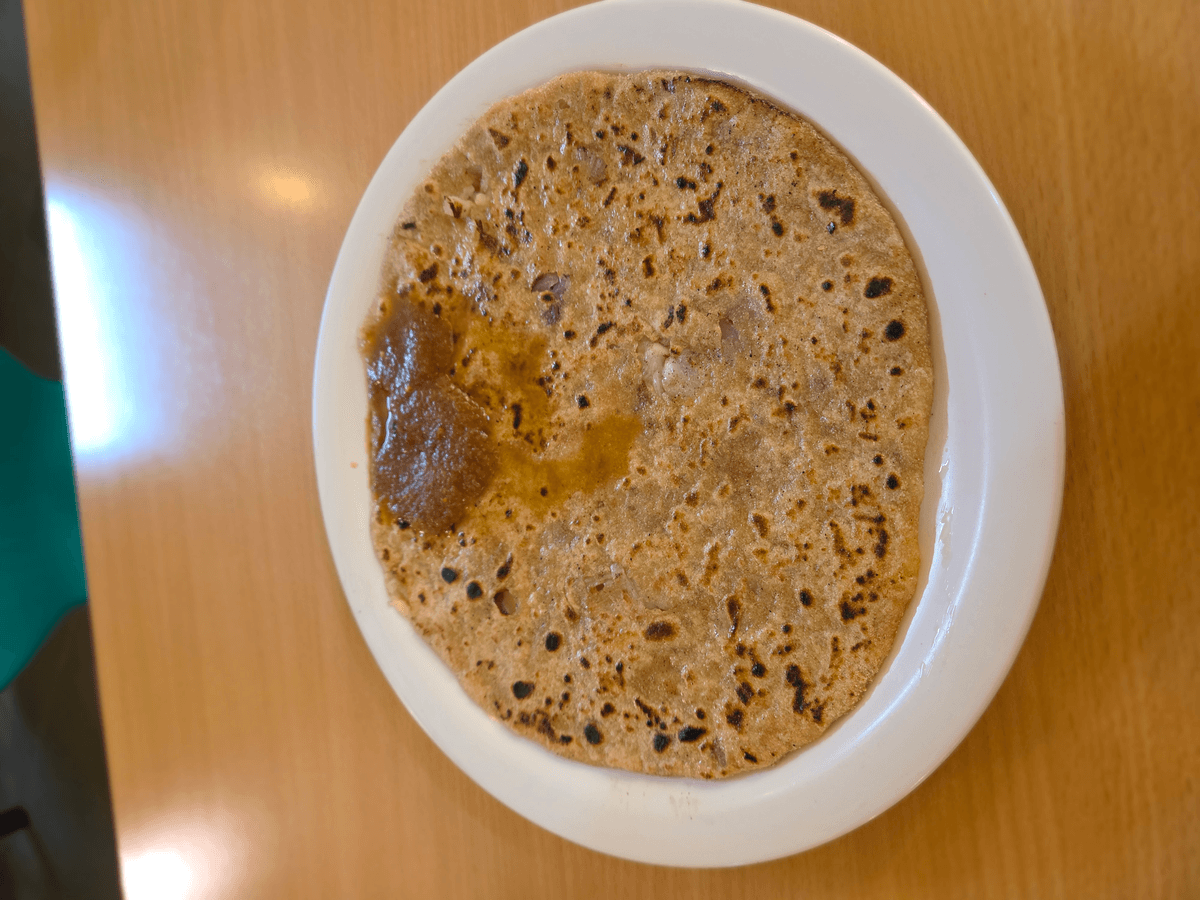
Short answer: one medium homemade aloo paratha, around 120 grams with a proper potato filling and a teaspoon of ghee on the tawa, carries about 250-320 calories. Per 100 grams, expect 230-280 kcal. A dhaba or restaurant version can land at 380-480, and it is rarely the potato's fault.
An aloo paratha is three things pretending to be one: wheat dough, a spiced potato filling, and whatever fat it was cooked in. The dough and the filling are the predictable part. The fat is the variable that swings the whole number, because one extra teaspoon of ghee adds roughly 45 calories to a flatbread that otherwise costs about 260.
The filling itself is the lightest part of the deal. Boiled potato is 87 calories per 100 grams, with 1.9 g of protein and almost no fat (0.1 g), per USDA FoodData Central. Your potato filling is mostly water and starch. A paratha stuffed generous with aloo is actually a paratha where some high-density ghee-soaked dough got displaced by low-density potato. Stuffed parathas with more filling and less dough can come out lighter than skimpy ones, which surprises people.
Aloo paratha calories and macros
| Version | Portion | Calories | Protein | Carbs | Fat |
|---|---|---|---|---|---|
| Homemade, light ghee (1 tsp on tawa) | 1 medium (~120 g) | 250-320 | 6-8 g | 40-46 g | 8-12 g |
| Homemade, dry-roasted, no ghee | 1 medium (~120 g) | 210-270 | 6-8 g | 40-46 g | 3-6 g |
| Homemade, generous ghee (2 tsp) | 1 medium (~120 g) | 340-400 | 6-8 g | 40-46 g | 15-20 g |
| Dhaba / restaurant, butter on top | 1 large (~160 g) | 380-480 | 8-10 g | 50-58 g | 18-26 g |
| Average | 100 g | 230-280 | 5-6 g | 32-37 g | 7-12 g |
Build it from the components and the numbers make sense. Roughly 50 g of whole wheat atta is about 185 kcal (whole wheat flour runs about 370 kcal per 100 g, per USDA FoodData Central). Seventy grams of boiled potato filling adds about 60. One teaspoon of ghee adds about 45. Total: just under 300, right in the middle of the table. Recipe-based estimates agree: nutrition trackers put aloo paratha at 230-280 kcal per 100 g for lighter versions, rising past 310 per 100 g when the recipe cooks in heavy ghee. The spread is the fat story, again.
For comparison, a plain paratha runs 150-220 kcal with 4-5 g of protein, and an anda paratha brings the egg's protein to 8-10 g. The aloo paratha sits in between on calories but lower on protein, because potato adds carbs without much protein. If breakfast is your one shot at a filling meal, that matters.
Why dhaba parathas run so heavy
Watch a dhaba cook make one and you see it. The paratha is bigger, the tawa gets a ladle of ghee instead of a brush of oil, and then a dollop of white butter goes on top while it is still hot, melting into the layers. Each of those steps is honest cooking and each adds 40-80 calories. Two dhaba aloo parathas with butter and a sweet doodh patti can cross 1,000 calories before the day has properly started. Nobody's kitchen scale is involved at a dhaba, so treat the top of the range as the working number there.
Homemade versions swing the other way. Some people roll the filling thin and the dough thick, which raises the calorie share of the dough. Some stuff a mountain of aloo with barely any ghee. If your paratha has a filling you can actually see breaking through the dough, it is probably landing lower than the same-sized paratha with a thin, oily layer of potato.
How to track it in seconds
In CalsFlow, type:
"2 homemade aloo parathas, medium, light ghee, plus half a cup of dahi"
You get the calorie and macro estimate plus the assumptions behind it: the piece weight it guessed, the ghee allowance, the filling ratio. If your mother used two teaspoons of ghee per paratha instead of one, say so and the number moves with it. Eating out? The dhaba allowance is its own setting. For the full playbook, our guide to counting calories in Pakistani and desi food covers the same honest-entry approach across the whole cuisine, and the Pakistani food calorie chart lines this up against everything else on the breakfast table.
Making aloo paratha work in a diet
Nothing about aloo paratha is off limits, but the sides decide the meal. Dahi is the classic pairing for a reason: a cup of plain dahi adds 5-7 g of protein and costs about 100 calories, and the paratha itself is short on protein. Pickle adds almost nothing but goes straight to your salt intake, so keep that honest if you track sodium.
What actually changes the number: measure your ghee for one week so you know what your spoon really adds, because most people underestimate it by half. Cook the paratha on a well-seasoned tawa so it needs less fat to crisp. And if you love the butter-on-top ritual, count it as a second teaspoon of ghee rather than pretending it melted into nothing.
One more thing worth knowing: a leftover cold aloo paratha eaten for breakfast reheats fine and the cooled potato develops some resistant starch, which is a gentler form of carbohydrate for digestion. That is a nice bonus, not a diet strategy. The diet strategy remains the same: one paratha, honest ghee, dahi on the side.
FAQs
How many calories are in 1 aloo paratha? About 250-320 kcal for a medium homemade one (~120 g) cooked with a teaspoon of ghee. A large dhaba paratha with butter on top runs 380-480.
How many calories are in 2 aloo parathas? Roughly 500-640 kcal for two medium homemade ones with light ghee, up to 900-960 for two ghee-heavy dhaba parathas with butter.
How many calories are in 100 g of aloo paratha? About 230-280 kcal per 100 g for typical homemade versions, rising past 310 per 100 g in recipes cooked with heavy ghee.
Does aloo paratha have protein? Some: 6-8 g in a medium homemade paratha, mostly from the wheat. It is not a protein food, which is why the traditional dahi pairing makes nutritional sense. Compare with an anda paratha, which nearly doubles the protein with an egg.
Is aloo paratha good for weight loss? It can fit. The fiber from whole wheat and the filling keep you full, and the potato itself is low in fat. Keep the ghee to one measured teaspoon, stick to one paratha, and let dahi provide the protein. The version that breaks diets is the dhaba double with butter, eaten on autopilot.
Hungry for a paratha with a stuffing-to-dough ratio all your own? Describe it in CalsFlow with your actual size and ghee, and it estimates the range honestly. Knowing whether yours lands at 260 or 420 is the difference between a plan and a guess.
CalsFlow provides nutrition estimates, not medical advice.
Cover photo: Aloo paratha by Gannu03, via Wikimedia Commons, licensed under CC BY-SA 4.0.