

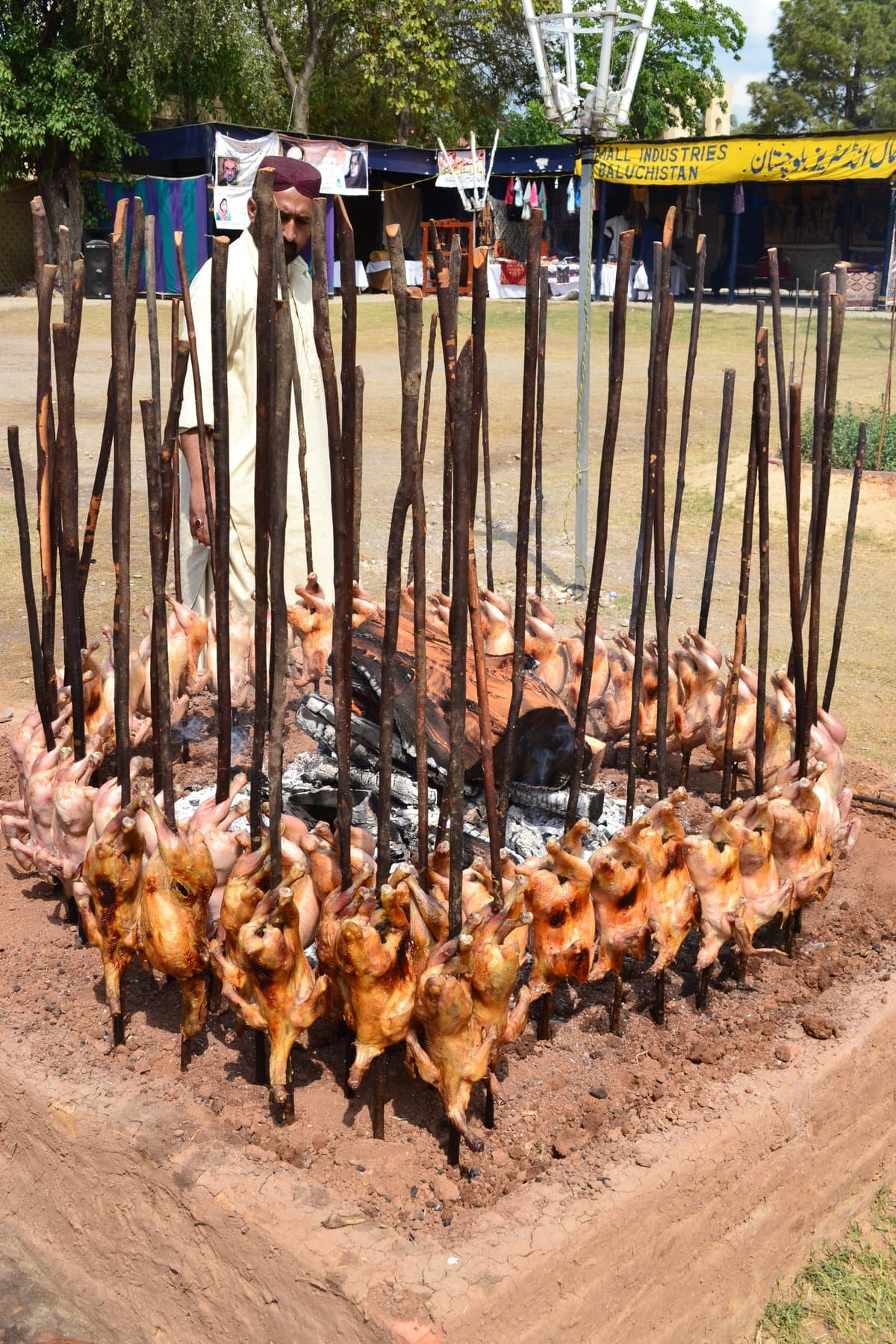
Short answer: a quarter plate of chicken sajji lands around 250 to 450 calories, and a half chicken around 500 to 900. Per 100 grams, sajji with the skin on sits at roughly 190 to 240 kcal, which makes it one of the lighter options on a Pakistani BBQ menu. The range comes down to three things: how much chicken you actually eat, whether the skin stays on, and how much rice comes with it.
Sajji started as a Balochi specialty and has gone national. A whole chicken, marinated in little more than salt and sajji masala, roasted upright over coals until the skin crisps. No gravy, no oil bath, no deep fryer. That is the whole calorie story in one sentence: almost everything on the plate is roasted chicken.
What decides the number
The portion. Restaurants sell sajji by the quarter or the half, sometimes as a whole bird laid over a platter of rice. A quarter sounds modest until you remember it is a quarter of a whole bird, bone included. The edible meat on a typical dhaba quarter runs 150 to 200 grams, and that is where the 250 to 450 range comes from.
The skin. The skin turns crisp and golden over the coals, and it carries most of the fat on the plate. Leaving it uneaten drops the calories by roughly a quarter. Nobody at the table will object if you peel it off.
The rice. Traditional sajji is stuffed with rice or served over a bed of it, and the rice soaks up the drippings. A cup of tarka rice adds 200 to 250 kcal, and a generous dhaba serving can run to two cups. The rice often contributes more calories than the chicken itself.
Oil and salt. Some places brush the bird with oil as it roasts, which pushes the numbers toward the top of the range. Sajji masala sprinkled on top is mostly ground spices and salt, nearly calorie free, but the salt itself is worth a mention. Sajji is aggressively salted, and a serving can carry close to a gram of salt. WHO recommends adults stay under 5 g of salt a day (who.int), so one sajji dinner can quietly use up a chunk of that.
Chicken sajji calories and macros
| Portion | Calories | Protein | Carbs | Fat |
|---|---|---|---|---|
| 100 g sajji, meat with skin | 190–240 | 24–28 g | ~1 g | 10–14 g |
| 100 g sajji, skinless | 140–170 | 25–29 g | ~1 g | 4–7 g |
| Quarter chicken sajji, skin on (~200 g edible) | 250–450 | 35–48 g | ~1 g | 12–20 g |
| Quarter chicken sajji, skin removed | 200–330 | 36–46 g | ~1 g | 6–10 g |
| Half chicken sajji, skin on | 500–900 | 70–95 g | ~2 g | 24–40 g |
| Quarter sajji + 1/2 cup tarka rice | 350–600 | ~38 g | ~25 g | ~14 g |
| Half sajji + 1 cup tarka rice (typical dhaba plate) | 700–1,100 | ~75 g | ~45 g | ~28 g |
These cross check against the base ingredient. USDA's FoodData Central puts grilled skinless chicken breast around 165 kcal per 100 g, and roasted chicken eaten with the skin runs 190 to 240 (fdc.nal.usda.gov). A recipe breakdown of Baluchi-style chicken sajji comes out near 240 kcal per quarter serving with 40 g of protein, right inside the table's range. The restaurant end of the range accounts for oil basting and bigger birds.
Logging it in CalsFlow
Type "half chicken sajji + 1 cup rice" into CalsFlow and it starts from roast chicken with skin and plain cooked rice: about 700 to 1,100 kcal. Tell it you ate the skin and the rice was tarka rice cooked in oil, and it revises toward the top of the range, around 950 to 1,050. Leave the skin off and it drops to roughly 600 to 750. That back and forth is the point. The assumptions stay visible, so you can correct them instead of trusting a single magic number.
Sajji vs the rest of the BBQ menu
Chicken tikka still wins on pure leanness: a piece runs 60 to 130 kcal, and our chicken tikka calories page has the full breakdown. But a tikka plate is smaller food. Ounce for ounce, sajji and tikka are close; the difference is that a sajji order is a quarter or half bird.
Against chicken karahi the gap is clearer. Karahi is simmered in oil and tomato, and a restaurant plate can carry several tablespoons of oil before the first roti appears. Our chicken karahi calories breakdown shows why one plate can swing so much. Sajji is dry roasted, so for the same weight of meat it almost always lands lower.
Mutton and lamb sajji exist too, and they run higher than the chicken version because the meat is fattier. If you order lamb, add roughly a third to the numbers above.
Common questions
Is chicken sajji good for weight loss? It is one of the better restaurant orders. High protein, no gravy, no frying. The traps are the rice and the skin, which is the whole story of our daily calorie guide. A quarter with the skin off and half a cup of rice fits a cutting day comfortably.
How many calories in half a chicken sajji? Around 500 to 900 with the skin on, 400 to 650 without. Add 200 to 250 per cup of rice.
Does sajji have a lot of salt? Yes. The salt-only marinade plus sajji masala means a serving can carry close to a gram of salt. If you are watching blood pressure, this matters more than the calories.
How much protein is in chicken sajji? Plenty. A quarter gives roughly 35 to 48 g, a half 70 to 95 g. Our protein guide puts that in context.
The bottom line
Chicken sajji: 250 to 450 kcal per quarter, 500 to 900 per half, 190 to 240 per 100 g with the skin on. The skin and the rice decide where you land. Logging sajji this weekend? Describe it in CalsFlow with the quarter or half, the skin, and the rice spelled out, and get your real number.
Cover photo: Khalid Mahmood via Wikimedia Commons (CC BY-SA 3.0).
CalsFlow provides nutrition estimates, not medical advice.